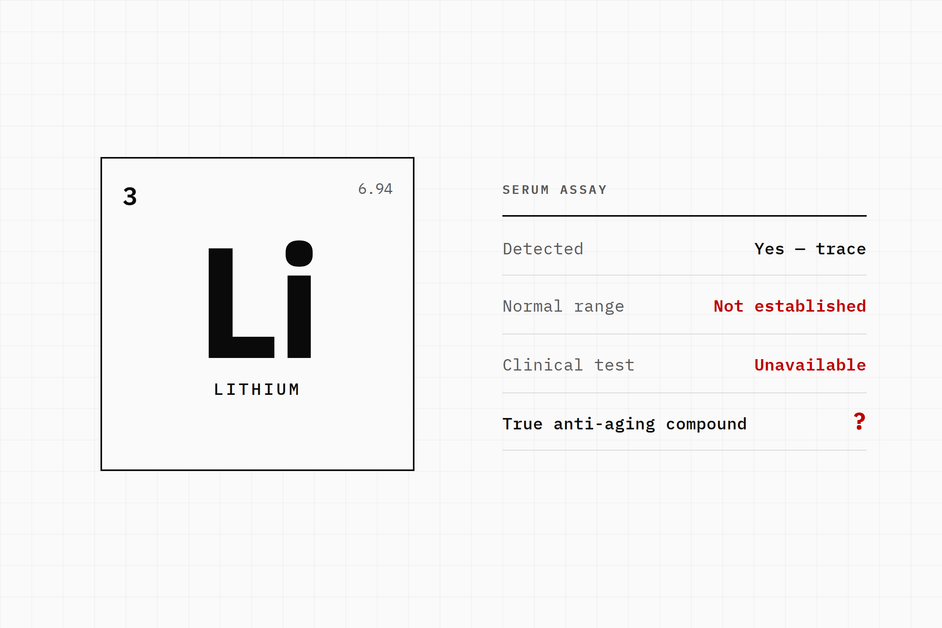
You have lithium in you right now. Not as a drug, and not as a supplement. Tiny amounts come in through grains, vegetables, and water. Here is the strange part. Nobody can tell you whether the amount in your body is normal, low, or high. There is no reference range for it, and no standard blood test built to find one.
That gap went unnoticed for seventy-five years. It survived a poisoning scandal, the rise of lithium as a psychiatric drug, a wave of population studies, and a supplement boom. Then in 2025, a lab finally pointed a sensitive instrument at ordinary brains, the kind that had never been dosed with lithium, and asked a simple question: how much is actually in there? This article lays out the evidence behind that question. It also explains why the answer, as striking as it is, still does not tell you what dose to take.
Why a shortage this small could matter
Picture a neuron as a railway line. The materials the cell needs have to travel the full length of that line. They ride along internal tracks. Those tracks are held down by a protein called tau, the same way railway ties hold rails to the ground.
An enzyme called GSK-3β acts as the maintenance crew for the line. Loosening the ties now and then is normal work. It is how the cell repairs and relays its own tracks. In a healthy brain, the crew works at a steady pace and the line stays open. Lithium appears to be one of the things that sets that pace. It holds the enzyme back.
Take lithium away, at least in mice, and the crew does not stop. It speeds up. Ties come loose faster than the cell can replace them. Once enough are gone, tau lets go of the track completely. The loose tau curls up and clumps together with other loose tau. Those clumps are the tangles found in the brains of people with Alzheimer's.¹
That is the mechanism proposed by the 2025 Nature paper. To their credit, the authors point out the biggest problem with it themselves. The lithium naturally present in the brain sits about a thousand times lower than the dose used to treat bipolar disorder. For a trace amount that small to switch off an enzyme directly is not something scientists expected to be possible, and the paper does not solve that puzzle. What it does show is narrower, but still real. When lithium runs low, the brain ends up with more of the GSK-3β enzyme overall, and more of it switched on. That is a change in how much active enzyme is present. It is not the same as proving that a trace of lithium reaches in and throttles each enzyme by hand. How lithium actually restrains it, at levels this low, is still an open question. The paper says as much.¹
The full case that lithium protects the brain
Before we test any of it, here is the strongest version of the pro-lithium argument. Every study in it is real.
The brain-structure case. Bipolar disorder is known to shrink the hippocampus, the part of the brain that files new memories. In 2012, a review pooled sixteen brain-imaging studies. It split them by whether most of each study's patients were taking lithium. In total that came to 101 patients on lithium, 245 not on lithium, and 456 healthy people for comparison.² The patients not on lithium had a hippocampus measurably smaller than the healthy group. The patients on lithium had one larger than the healthy group. The gap between the two was large.
The gray-matter-growth case. In 2000, a short Lancet report scanned ten bipolar patients before and after four weeks on lithium. There was no placebo group. It reported that their gray matter had grown.³ Ten years later, a randomized study compared lithium against another mood drug, valproic acid, in 22 patients, again with no placebo. The patients whose gray matter grew the most were the ones who improved the most.⁴ The obvious reading was that lithium builds brain tissue.
The longevity case. In 2011, a group compared the lithium level in tap water against death rates across eighteen towns in Oita, Japan, covering 1.2 million people. They found an inverse link: more lithium in the water, fewer deaths from any cause.⁵
The essential-nutrient case. Rats and goats raised on feed stripped of lithium show higher death rates and trouble reproducing. That is the classic signature of a nutrient the body actually needs. In 2002, the chemist Gerhard Schrauzer, who also ran the first Texas water study, used that animal data to propose a provisional requirement of about 1 mg a day for a 70 kg adult.⁶
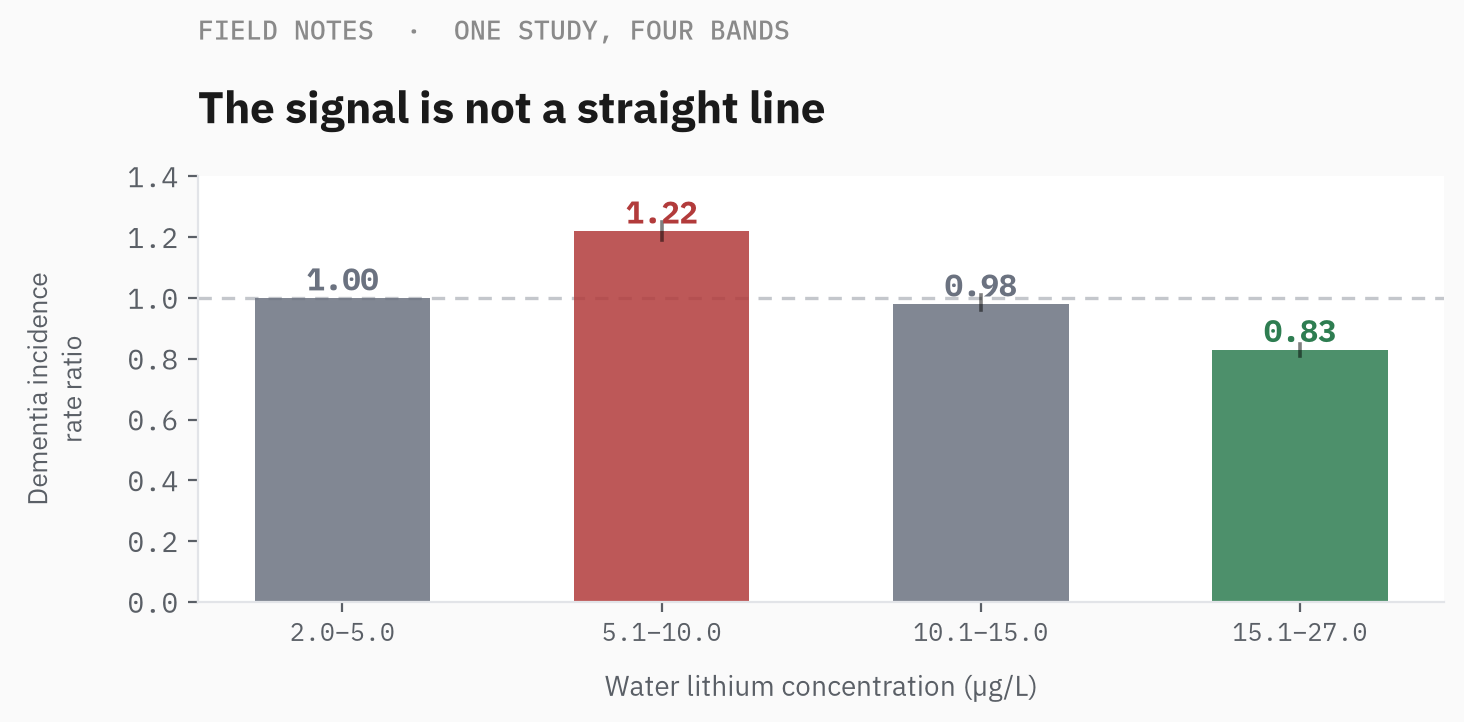
The dementia case. In 2017, a Danish team estimated the water-lithium level across the whole country. They then matched 73,731 people who were diagnosed with dementia against 733,653 people who stayed healthy.⁷ Among the people with the most lithium in their water, dementia was 17% less common than among those with the least. A 2024 review pooled seven earlier studies and found that people prescribed lithium for psychiatric reasons had roughly 41% lower Alzheimer's risk.⁸
So: an element already inside you, that seems to protect brain structure, seems to grow tissue, tracks with fewer deaths, tracks with less dementia, and that animal biology suggests you may actually need. That is the complete case. Now watch what happens when you test each piece on its own.
The signal fades as you zoom from populations to people
A quick note before the results. Where a study found lithium linked to lower risk, this section calls it protective. Where it found lithium linked to higher risk, it calls it harmful. Where the study looked and found no real difference, it calls it null. The raw statistics behind each result are in the table further down, for anyone who wants to check them. The prose sticks to what the numbers mean.
The direct trials. In 2009, six memory clinics gave lithium to 71 patients with mild Alzheimer's for ten weeks, against placebo, at a full psychiatric dose.⁹ The two main things they measured were not memory scores but biological markers: a form of tau in spinal fluid, and GSK-3 activity in blood cells. Neither one moved.
The other key trial came out this year, from the University of Pittsburgh, in JAMA Neurology.¹⁰ It used a deliberately low dose, low enough to sit well under the psychiatric range, and ran for two full years in 80 people with mild cognitive impairment. The team named six main outcomes in advance. None of the six cleared the bar the trial had set for itself. On memory, the lithium group did decline more slowly than placebo, but even that result fell just short of the bar. Four of the other five outcomes were flat. The last one, the size of the hippocampus, leaned the same way as the memory result but again did not clear the bar.
Back to the brain-structure claim. In 2013, a Newcastle University team asked a sharp question: does lithium actually grow tissue, or does it just look that way on a scan? They gave lithium or placebo to healthy young men, not bipolar patients, for 11 days. Then they measured brain volume two different ways. One method reads the brightness of the signal. The other reads the physical edges of the tissue. The brightness method showed growth. The edge method showed nothing. They also found that lithium changed a magnetic property of the tissue itself. The authors were careful with their conclusion: the earlier finding of "growth" might be a change in the signal rather than a real gain in volume. Nobody has ruled that out since.¹¹
Back to the longevity claim. In 2024, a King's College London team searched the UK Biobank, a large health database, and found everyone with a lithium prescription. They tested how long people had taken it against three markers of biological aging: telomere length, frailty, and a metabolic age score. They found no link to any of them.¹² The authors are clear about the limit here. This compares longer versus shorter use among people already on lithium, not lithium versus none, so it does not by itself overturn the death-rate studies. But it is a clean miss on the exact aging mechanisms those studies pointed to.
Back to the nutrient claim. Read further into that same 2002 Schrauzer review, the one that proposed the 1 mg figure, and it says plainly that no lithium deficiency disease has ever been identified in a human being. The 1 mg number is an estimate drawn from animal death rates. No health authority has adopted it.⁶
From populations down to people. This is where the pattern comes into focus. The table below lists every water-lithium study behind the "four countries, four decades" claim. For each one it shows the actual concentration and the result at that level, not just a single correlation number.
|
Study |
Water Li level |
Design |
Result at that level |
Direction |
|
Kessing 2017⁷ |
2.0–5.0 µg/L |
Danish nationwide, 73,731
cases / 733,653 controls |
reference band |
n/a |
|
Kessing 2017 |
5.1–10.0 µg/L |
same |
IRR 1.22 (95% CI 1.19–1.25) |
harmful |
|
Kessing 2017 |
10.1–15.0 µg/L |
same |
IRR 0.98 (0.96–1.01), n.s. |
null |
|
Kessing 2017 |
15.1–27.0 µg/L |
same |
IRR 0.83 (0.81–0.85) |
protective |
|
Schrauzer 1990¹³ |
0–12 vs 70–160 µg/L |
27 Texas counties, terciles,
1978–1987 |
suicide rate ≈14 vs ≈9 per
100,000 |
protective |
|
Ohgami 2009¹⁴ |
0.7–59 µg/L (continuous) |
18 municipalities, Oita,
Japan |
negative correlation with
suicide SMR |
protective |
|
Kapusta 2011¹⁵ |
mean 11.3 µg/L, up to 82.3
(continuous) |
99 Austrian districts, 6,460
measurements |
β=−0.39 to −0.41, P<.0001 |
protective |
|
Blüml 2013 (Texas)¹⁶ |
not retrievable (full text
unreachable) |
226 Texas counties, 3,123
measurements |
negative association in most
models |
protective |
|
Kabacs 2011¹⁷ |
<1–21 µg/L (continuous) |
47 East of England
subdivisions, no covariate adjustment |
r=−0.03, P=0.84 |
null |
|
Oliveira 2019¹⁸ |
mean 10.9 µg/L, max 191
(continuous) |
54 Portuguese
municipalities, 2011–2016 |
r=0.001, P=0.996 |
null |
|
López Steinmetz 2021¹⁹ |
up to 2,980 µg/L
(continuous) |
rural Argentinean Andes,
Lithium Triangle |
ρ=+0.76, P<0.001 |
harmful |
|
Knudsen 2017²⁰ |
31 µg/L threshold,
individual-level |
3.7 million Danish adults,
22-year follow-up |
no protective effect below
threshold |
null |
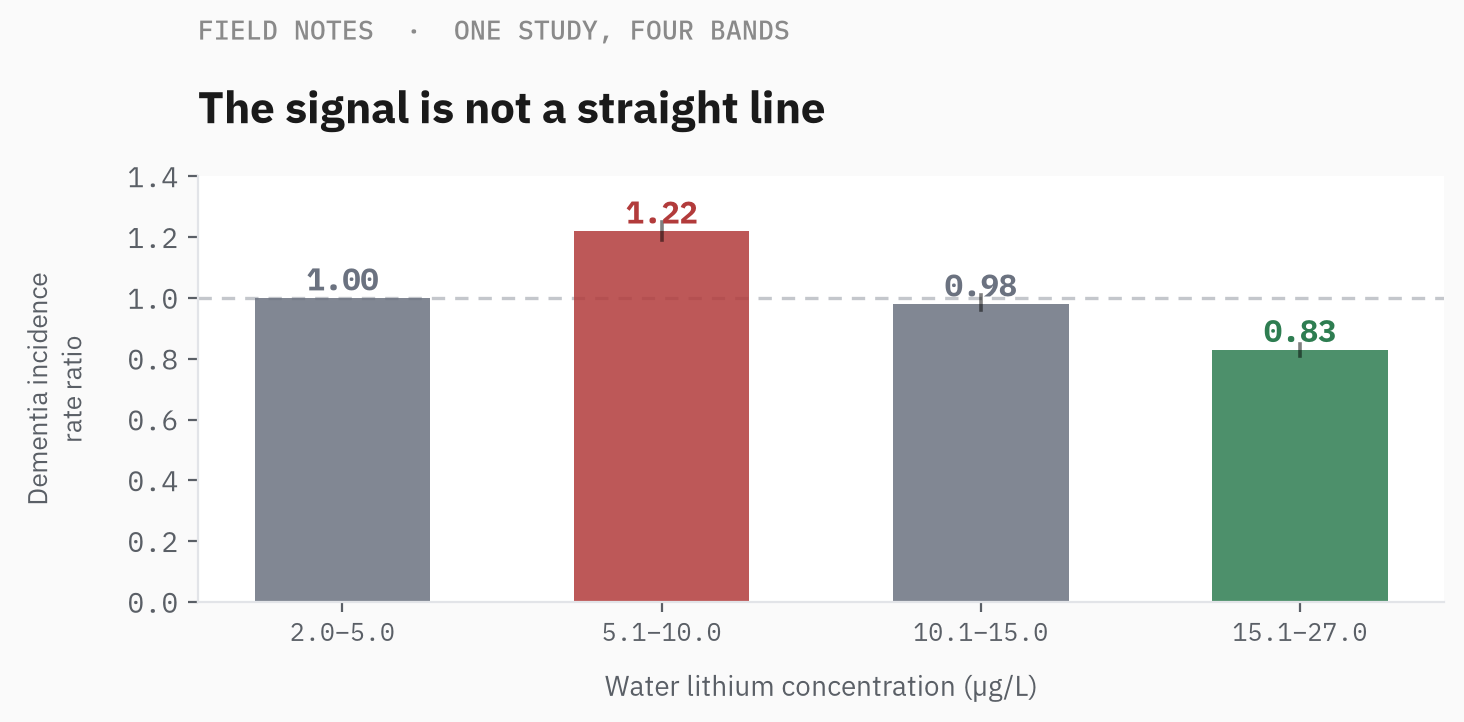
The table shows two things a single correlation number would hide. First, only the Kessing study broke lithium into separate dose bands with a baseline to compare against. Every other study here treated water lithium as one continuous trend line. So "four countries agree" quietly lumps together studies whose designs are not really comparable. Second, even Kessing's own bands do not line up neatly. The second-lowest band is not just weakly protective, it is harmful, and the paper offers no specific reason for that reversal.
The biggest test of all sits outside the table, because it does not use water bands at all. A separate Danish team followed 3.7 million adults as individuals, not as regions, for 22 years. They drew on the same national records that produced the Kessing dementia result, but this time they studied suicide instead of dementia. They found no real link between more lithium exposure and lower suicide risk. They state it plainly: there does not appear to be a protective effect at the lithium levels Danish water actually contains.²⁰ That is a direct clash with the region-level studies around it, built from overlapping data.
There is one more check worth running on the whole field. When Eyre-Watt and colleagues pooled 27 region-level water studies covering 113 million people, they ran a formal test for publication bias. Publication bias is the tendency for studies that find an effect to get published while studies that find nothing sit in a drawer. The test came back positive, which is the statistical fingerprint of exactly that: null studies that were run and quietly never published.²¹
So here is where the pillars stand. The direct trials came back null or borderline. The brain-growth claim may be a scanner effect. The longevity mechanism shows nothing in the people who actually took lithium. The nutrient case has no deficiency to point to. And the water signal, real as it looks in the aggregate, thins out or vanishes every time someone tracks individuals with known exposure instead of whole regions. That is the pattern, and it repeats across every pillar: strong at the level of populations, weak or gone at the level of people.
The reading-glasses problem
Every trial above shares one thing. It is not a flaw in how the trial was run. It is an assumption baked in before the trial even started.
Hand out reading glasses to everyone in a room and measure the improvement. The average result comes back near zero. Not because the glasses fail. Because most of the room could already see fine, and the few who truly needed them get averaged in with everyone who did not. Run that same experiment on the whole room a dozen times and you would "prove" that reading glasses do nothing.
No finished lithium trial has used a person's own lithium level to decide whether to give them lithium. The 2009 trial and the Pittsburgh trial both ran on the same logic: enroll people by diagnosis, assign lithium or placebo, measure the result. Neither one asked, at the start, who in the room already had enough lithium and who was short.
One trial did take that measurement, and its result is the sharpest number in this whole story. A Dundee pilot trial measured each of its 11 participants' blood lithium before any dosing began.²² Every single reading came back below 0.2 mmol/L, which is simply the lowest level the test can detect. The instrument could not even see the thing the trial needed to know. So the honest claim is not "nobody ever measured a baseline." The sharper and more accurate claim is this: no trial has ever used a baseline lithium reading to choose, sort, or dose its participants, and the one baseline that did get published came back under the floor of what a normal clinical test can read.
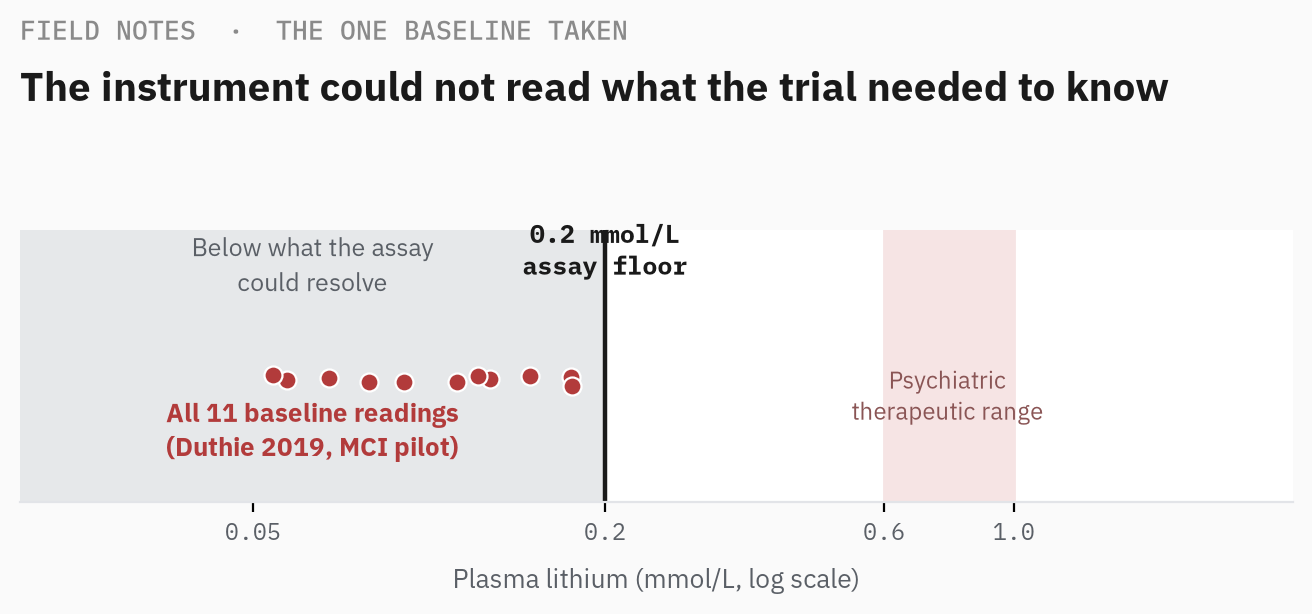
The instrument problem runs deeper than one trial. The standard lithium blood test exists to keep already-treated patients out of toxic territory. Its useful range starts about twenty times higher than where your body's natural lithium sits. So at ordinary background levels, the test is essentially blind. On top of that, for decades researchers took Alzheimer's brains apart and screened them for suspect metals, and lithium was never on the list. It was not a suspect, so it was never checked, one way or the other. And every earlier lithium brain scan of a living person had been done on someone already being treated with lithium. Nobody had aimed that kind of instrument at an ordinary, undosed brain to ask how much belonged there in the first place.
In 2025, someone finally did.
The measurement that changes the question
The 2025 Nature paper is not another population study. It measured lithium directly in brain tissue taken after death, across two separate groups of brains, using a high-precision method called mass spectrometry. And it is careful about what it claims. Lithium was already lower in people with mild cognitive impairment. But that stage already has symptoms, so it is not truly "before symptoms." Saying lithium "falls before symptoms arrive" overstates it. The real finding is still striking on its own: the drop is already there at the earliest diagnosable stage of decline.
The second finding is what the paper calls sequestration. In plain terms: the lithium is not just low, it appears to get trapped inside the amyloid plaques themselves, pulled out of reach so the rest of the brain can no longer use it. That claim rests on three measurements that point the same way. Within a single brain, the plaque-heavy regions held proportionally less free lithium than the plaque-free regions. Alzheimer's brains held less lithium in the cortex overall. And a second, independent set of brains showed the same shortfall using the same method. What has been firmly confirmed is the human measurement itself: lower lithium in Alzheimer's brain tissue. What has not been fully explained is why the plaques bind it. The "locked away and unusable" picture is the readable version of what is, for now, a strong and independently repeated correlation.
Whether any of this justifies taking a capsule is exactly the question nobody has answered yet. Johns Hopkins is set to begin, this October, the first randomized, placebo-controlled trial of lithium orotate in Alzheimer's disease. (That start date is an estimate; as of mid-2026 the trial was still listed as not yet recruiting.)²³ Its design finally closes the instrument gap this article opened with. One of its secondary measures checks lithium directly in spinal fluid, to see what actually reaches the nervous system instead of assuming a capsule gets there. What it still does not do is use each person's baseline lithium to choose or sort participants. So the reading-glasses problem carries straight into this trial too.
Then there is the sales pitch itself. Supplement brands sell lithium orotate on the idea that the orotate "carrier" ferries lithium into cells better. That premise has been tested exactly once, and only from one angle. A 1976 study knocked down one specific prediction of the carrier idea, that orotate and carbonate should spread through and clear the body differently, using three dosing routes in rats. But no study, then or since, has ever directly shown or ruled out an intact lithium-orotate molecule reaching the brain. The mechanism has never been tested at the point that would actually settle it. So the industry claim is unproven, not disproven.
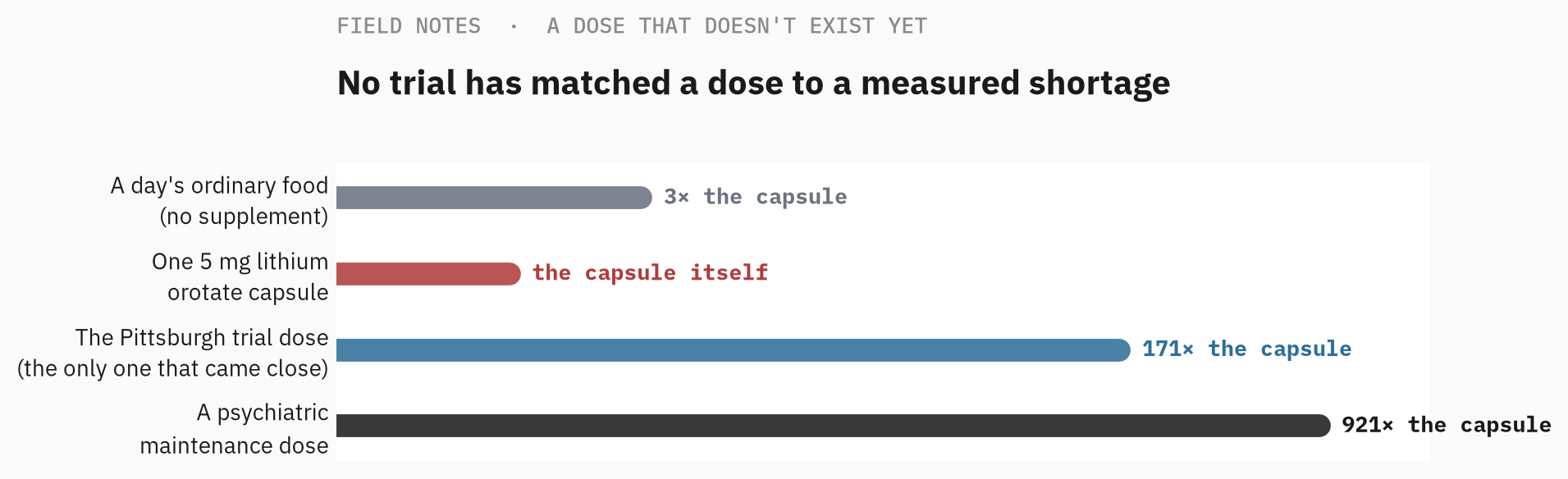
What holds up: a large, independently confirmed drop in brain lithium at the earliest symptomatic stage of Alzheimer's, plus a population-level water-and-dementia signal that has now repeated across a national database. What does not hold up: the anti-aging case built on gray-matter growth (probably a scanner effect), on telomere and biological-age markers (a clean miss in the people who actually took lithium), and on lithium as a proven essential nutrient (no human deficiency has ever been found). What is still open: whether restoring lithium in people who are genuinely short of it does anything at all, because no trial has yet been built to find out who is short before it doses them.
References
1. Aron L, et al. Lithium deficiency and the onset of Alzheimer's disease. Nature. 2025. PMID 40770094.
2. Hafeman DM, et al. Smaller hippocampal volumes in patients with bipolar disorder are masked by exposure to lithium: a meta-analysis. J Psychiatry Neurosci. 2012. PMID 22498078.
3. Moore GJ, et al. Lithium-induced increase in human brain grey matter. Lancet. 2000. PMID 11072948.
4. Lyoo IK, et al. Lithium-induced gray matter volume increase as a neural correlate of treatment response in bipolar disorder: a longitudinal brain imaging study. Neuropsychopharmacology. 2010. PMID 20357761.
5. Zarse K, et al. Low-dose lithium uptake promotes longevity in humans and metazoans. Eur J Nutr. 2011. PMID 21301855.
6. Schrauzer GN. Lithium: occurrence, dietary intakes, nutritional essentiality. J Am Coll Nutr. 2002. PMID 11838882.
7. Kessing LV, et al. Association of Lithium in Drinking Water With the Incidence of Dementia. JAMA Psychiatry. 2017. PMID 28832877.
8. Lu Q, et al. Lithium Therapy's Potential to Lower Dementia Risk and the Prevalence of Alzheimer's Disease: A Meta-Analysis. Eur Neurol. 2024. PMID 38657568.
9. Hampel H, et al. Lithium trial in Alzheimer's disease: a randomized, single-blind, placebo-controlled, multicenter 10-week study. J Clin Psychiatry. 2009. PMID 19573486.
10. Gildengers AG, et al. Low-Dose Lithium for Mild Cognitive Impairment: A Pilot Randomized Clinical Trial. JAMA Neurol. 2026. PMID 41770546.
11. Cousins DA, et al. Lithium, gray matter, and magnetic resonance imaging signal. Biol Psychiatry. 2013. PMID 23158114.
12. Mutz J, et al. The duration of lithium use and biological ageing: telomere length, frailty, metabolomic age and all-cause mortality. Geroscience. 2024. PMID 38539016.
13. Schrauzer GN, Shrestha KP. Lithium in drinking water and the incidences of crimes, suicides, and arrests related to drug addictions. Biol Trace Elem Res. 1990. PMID 1699579.
14. Ohgami H, et al. Lithium levels in drinking water and risk of suicide. Br J Psychiatry. 2009. PMID 19407280.
15. Kapusta ND, et al. Lithium in drinking water and suicide mortality. Br J Psychiatry. 2011. PMID 21525518.
16. Blüml V, et al. Lithium in the public water supply and suicide mortality in Texas. J Psychiatr Res. 2013. PMID 23312137.
17. Kabacs N, et al. Lithium in drinking water and suicide rates across the East of England. Br J Psychiatry. 2011. PMID 21525523.
18. Oliveira P, et al. Lithium in Public Drinking Water and Suicide Mortality in Portugal: Initial Approach. Acta Med Port. 2019. PMID 30753803.
19. López Steinmetz LC, et al. Lithium in drinking water, altitude, and suicide rates in rural areas of the Argentinean Andes. Spat Spatiotemporal Epidemiol. 2021. PMID 33509433.
20. Knudsen NN, et al. Lithium in Drinking Water and Incidence of Suicide: A Nationwide Individual-Level Cohort Study with 22 Years of Follow-Up. Int J Environ Res Public Health. 2017. PMID 28604590.
21. Eyre-Watt B, et al. The association between lithium in drinking water and neuropsychiatric outcomes: A systematic review and meta-analysis from across 2678 regions containing 113 million people. Aust N Z J Psychiatry. 2020. PMID 33045847.
22. Duthie AC, et al. Recruitment, Retainment, and Biomarkers of Response; A Pilot Trial of Lithium in Humans With Mild Cognitive Impairment. Front Mol Neurosci. 2019. PMID 31316348.
23. ClinicalTrials.gov. NCT07459959. Randomized, placebo-controlled trial of lithium orotate in Alzheimer's disease, Johns Hopkins University. Status verified June 2026: not yet recruiting, estimated start October 2026.