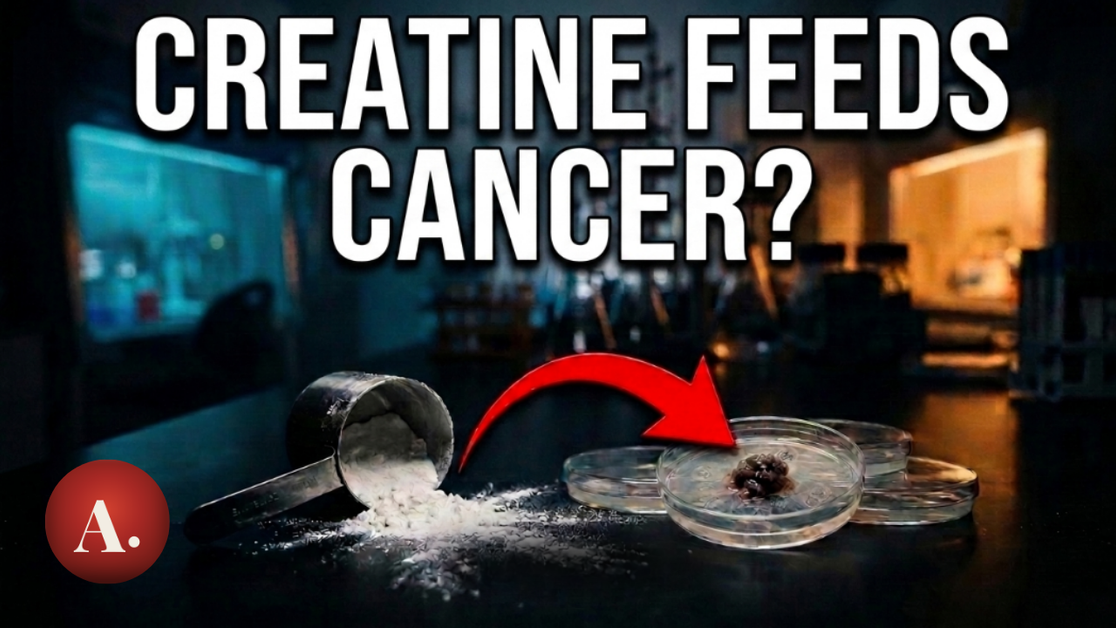
Creatine is one of the most-studied supplements in the world, taken by millions of people who have been told for years it is about as safe as anything on the shelf. Then, within weeks of each other, two peer-reviewed studies reached opposite conclusions about what it does to cancer. One found that creatine helped cancer spread faster through the body. The other found that creatine helped the body fight cancer off. Same molecule, serious labs, and results that cannot both be simple. This investigation starts with the alarming study, published only days ago, and takes it apart: what it actually measured, what it measured only in mice, and what it never measured in a human at all. Then it does what the headlines will not, setting that study against the wider body of research to answer the only question that matters for the person taking it. Is creatine feeding cancer, or is something more ordinary going on?
0:00 – Introduction
1:04 – The New Study on Creatine and Cancer
3:22 – Other Studies Findings
6:38 – The Real Explanation
8:41 – A Study on Cancer Patients
9:54 – What's Still Unknown
IN THIS INVESTIGATION
- What a brand-new study found when it gave creatine to animals with cancer, and the single detail in its human data that changes how much it should worry you.
- Why platelets, the cells that clot a cut, have a second life that helps cancer survive the journey through your bloodstream.
- How the same supplement, in the same kind of cancer, shrank tumors in one lab while spreading them in another, and the one idea that makes both results true at once.
- Why "cancer cells use it" has never meant "stop consuming it," and what glucose and protein reveal about the way tumors feed.
- What actually happened when creatine was given to hundreds of real cancer patients in a randomized trial, and the two questions the science still has not answered.
REFERENCES
Xie et al. Exogenous creatine supplementation promotes tumor metastasis via megakaryocyte creatine kinase B-STAT5B signaling. Nat Commun, 2026. PMID 42449108
Kang et al. Creatine uptake promotes dendritic cell activation and enhances antitumor immunity. iScience, 2026. PMID 42006288
Di Biase et al. Creatine uptake regulates CD8 T cell antitumor immunity. J Exp Med, 2019. PMID 31628186
Samborska et al. Creatine transport and creatine kinase activity is required for CD8+ T cell immunity. Cell Rep, 2022. PMID 35235777
Peng & Saito. Creatine supplementation enhances anti-tumor immunity by promoting adenosine triphosphate production in macrophages. Front Immunol, 2023. PMID 37662917
Loo et al. Extracellular metabolic energetics can promote cancer progression. Cell, 2015. PMID 25601461
Papalazarou et al. The creatine-phosphagen system is mechanoresponsive in pancreatic adenocarcinoma and fuels invasion and metastasis. Nat Metab, 2020. PMID 32694686
Zhang et al. Creatine promotes cancer metastasis through activation of Smad2/3-mediated SNAIL1 transcription. Cell Metab, 2021. PMID 33811821
Fenouille et al. The creatine kinase pathway is a metabolic vulnerability in EVI1-positive acute myeloid leukemia. Nat Med, 2017. PMID 28191887
Patel et al. Cyclocreatine suppresses creatine metabolism and impairs prostate cancer progression. Cancer Res, 2022. PMID 35675421
Kurth et al. Therapeutic targeting of SLC6A8 creatine transporter suppresses colon cancer progression and modulates human creatine levels. Sci Adv, 2021. PMID 34613776
Jatoi et al. A double-blind, placebo-controlled randomized trial of creatine for the cancer anorexia/weight loss syndrome (N02C4): an Alliance trial. Ann Oncol, 2017. PMID 28475678
NOTE: This video is educational content. It is not medical advice.
Subscribe for more investigations. What should we investigate next? Leave it in the comments.