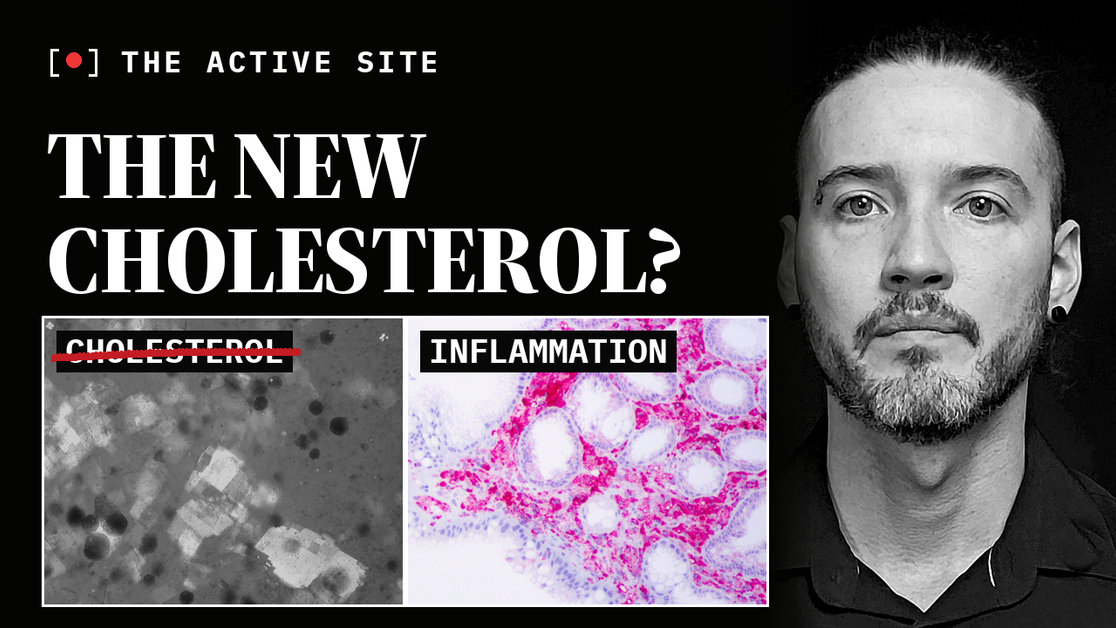
For decades, cholesterol has been blamed for heart disease, but some have argued that inflammation is the real culprit. In 2017 that idea got what looked like proof, when a drug cut heart attacks by calming inflammation while cholesterol stayed exactly where it was. A major cardiology group now recommends testing everyone's inflammation level alongside their cholesterol. Then, in November 2026, the biggest test yet of that idea reported its results. This investigation follows the evidence from inside the artery wall to that trial to find out whether inflammation really is the new cholesterol.
What this episode tested
Each claim the episode covers, and where the cited studies land. Numbers refer to the references below.
- Ziltivekimab prevents heart attacks, strokes, and cardiovascular death by lowering high-sensitivity C-reactive protein (hs-CRP).Not supported
In ZEUS, hs-CRP fell 64 percentage points more on ziltivekimab than on placebo, yet a heart attack, stroke or cardiovascular death occurred in 17.6% on the drug and 17.7% on placebo over a median of 33 months. The marker fell and events did not.
Refs 1 - A large drop in C-reactive protein is itself evidence that a treatment protects the heart.Not supported
ZEUS lowered hs-CRP by 64 percentage points more than placebo and left cardiovascular events unchanged. A treatment sold on lowering inflammation, supplements included, has to show fewer events, not only a lower lab number.
Refs 1 - Calming inflammation can reduce cardiovascular events without lowering low-density lipoprotein (LDL) cholesterol.Mixed
In CANTOS, canakinumab reduced major cardiovascular events in 10,061 people with a prior heart attack without lowering cholesterol, though fatal infections were more common. Methotrexate in CIRT lowered neither inflammation nor events.
- JUPITER proved that lowering inflammation, rather than cholesterol, prevents first heart attacks.Not a clean test
In JUPITER, rosuvastatin cut events in 17,802 people with raised hs-CRP, but it lowered LDL cholesterol by 50% as well as hs-CRP by 37%. The trial cannot say which change prevented the events.
Refs 2 - Low-dose colchicine reduces cardiovascular events, which is why Lodoco was approved.Mixed
Colchicine 0.5 mg daily reduced events in COLCOT and LoDoCo2, and the Food and Drug Administration approved it as Lodoco in 2023 on those results. Started soon after a heart attack in CLEAR SYNERGY, it did not help (9.1% against 9.3%).
- Inflammation is the new cholesterol: one number to measure and lower in everyone.Not supported
Some anti-inflammatory drugs have reduced events in some patients, but a 64-point drop in hs-CRP did not in ZEUS. Inflammation is not yet one number to measure and lower in everyone.
Timestamps
Transcript
Lightly cleaned from the episode's transcript.
Show full transcript
In November 2026, the New England Journal of Medicine published ZEUS, a large trial of a drug that targets the signal behind C-reactive protein, or CRP, the most widely used blood marker of inflammation in heart disease. On the drug, CRP fell by almost ninety percent, yet cardiovascular events were no lower than on placebo.
That result lands in the middle of one of medicine's loudest arguments. In two thousand and seventeen, a trial called CANTOS reduced heart attacks by calming inflammation while LDL cholesterol stayed where it was, and people who argue that LDL is not the real cause of heart disease took it as proof that inflammation is.
ZEUS was the next big test of that idea, and the gap between the two results is what needs explaining. It matters well beyond one drug because in two thousand and twenty-five, a scientific statement from the American College of Cardiology recommended measuring CRP in everyone alongside cholesterol on the reasoning that clinicians will not treat what they do not measure.
The hope that calming chronic inflammation could slow aging rests on the same idea. The expectation began decades before this drug inside the artery itself
In 1986, researchers examined plaque that surgeons had removed from the carotid arteries of 16 patients, the arteries that run up the neck to the brain. A plaque is a swelling inside the artery wall, a soft core of cholesterol and debris covered by a thin skin of tissue called the fibrous cap, which keeps that core away from the blood.
Inside these plaques, the researchers found large numbers of immune cells, macrophages, which swallow debris, and T cells, which direct other immune cells.
The T cells were gathered in the cap itself, the part that has to hold for the plaque to stay sealed
Findings like these grew into the inflammatory hypothesis of atherosclerosis, the idea that plaque is an immune response to cholesterol rather than a simple deposit of it. A splinter is a good example. The body cannot leave one alone. Immune cells crowd in to clear it, and the inflammation they cause lingers for as long as the splinter stays and can damage the tissue around it
Cholesterol itself is something every cell needs. In the artery, the splinter is LDL, the particles that carry cholesterol through the blood once they get trapped in the wall. Macrophages take these particles up and call in more immune cells, and the reaction that should clear the wall builds the plaque instead.
Most heart attacks begin when the thin cap sealing a plaque tears. The soft core underneath meets the blood and forms a clot, and inflammation helps drive that clotting. If the hypothesis was right, calming the reaction could prevent heart attacks even with the cholesterol still in the wall
Inflammation also shows up in the blood because inflammatory signals tell the liver to make CRP. That gave researchers a way to study it in people long before a heart attack with one built-in limit. CRP reads out the whole body, not any one plaque.
In 1997, a team led by Paul Ridker at Brigham and Women's Hospital in Boston measured CRP in stored blood from apparently healthy American male physicians. Men in the top quarter for CRP had about three times the risk of a first heart attack of men in the bottom quarter. Because the blood predated those heart attacks, CRP counted as a genuine predictor of risk.
The authors also suggested it might be standing in for interleukin-6, the protein signal that tells the liver to make CRP, 29 years before ZEUS went after that signal directly. Ridker would go on to lead many of the trials that followed, ZEUS included.
In 2008, his JUPITER trial gave a statin or placebo to apparently healthy people with normal LDL cholesterol but raised CRP, and the statin roughly halved first cardiovascular events. It lowered LDL and CRP together, though, which left open how much of that benefit came from calming inflammation. Telling the marker apart from the cause needed a different kind of evidence.
Genetics offered that evidence starting in 2008 when researchers in Copenhagen found that inherited gene variants raising CRP were not linked to the extra heart disease risk their higher CRP predicted.
Variants that raised cholesterol tested the same way did come with higher risk. By that test, cholesterol behaved like a cause of heart disease and CRP did not. In 2010, a study in Nature showed how cholesterol trapped in the artery wall sets off the immune reaction. Cholesterol crystals switch on the NLRP3 inflammasome, an alarm inside immune cells which releases interleukin-1 beta, a messenger protein that spreads the alarm by telling surrounding cells to step up inflammation.
In mice whose immune cells lacked that alarm, early plaque was much reduced. In 2012, two analyses of overlapping data looked one link further down the chain at interleukin-6 through a common variant in its receptor. Carriers had about three to five percent lower odds of coronary heart disease per copy consistent with a causal role for that signal
CRP looked like a bystander, and the chain above it looked like a suspect, though genetics can only point to a pathway, not say what a drug will do. The clinical test came in 2017 with CANTOS, led by the Ridker's group yet again, in people who had already had a heart attack and still had raised CRP. They received a placebo or canakinumab, an antibody against interleukin-1 beta.
Remember, that's the signal the alarm releases. Over nearly four years, people on the drug had about 15% fewer heart attacks, strokes, and cardiovascular deaths than on placebo with no fall in cholesterol. Inflammation had been calmed without touching cholesterol, and the ZEUS designers would later call it proof of principle for the inflammatory hypothesis of atherosclerosis, the first sign in patients that it could work.
And this was massive because for decades, the argument over heart disease had been fought almost entirely over cholesterol between those who treat it as the cause and those who doubt it matters at all. CANTOS was the first large trial to show fewer heart attacks in people whose cholesterol did not change.
It suggested that the body's reaction to cholesterol is part of what causes heart attacks, and that the reaction can be treated in its own right. Lowering LDL still works, and nothing in CANTOS argued otherwise, but it was no longer the only lever. Every trial that came after, ZEUS included, was an attempt to find out how far that second lever reaches.
Now interestingly, and keep this in mind, fatal infections were more common in the CANTOS trial
In 2018, Ridker's group looked back at the CANTOS patients and sorted them by how far their CRP fell after the first injection. Those whose CRP dropped to a low level had a quarter fewer heart attacks, strokes, and cardiovascular deaths than the placebo group, while the rest gained a little. It was tempting to read that as proof that lowering CRP was what protected people, but the trial had randomly chosen who got the drug, not whose CRP fell, and the people whose CRP fell furthest may simply have been healthier to begin with.
That left two questions for the trials that followed: whether a drug acting at a different point in the chain would also work, and whether pushing CRP even lower would protect people more
Colchicine, a cheap decades-old gout drug that dampens inflammation more broadly, then showed the effect was not limited to one expensive antibody.
In 2019, a trial run from the Montreal Heart Institute gave low-dose colchicine or a placebo to patients within a month of a heart attack. Over about two years, those on colchicine had more than a fifth fewer cardiovascular events than those on placebo. In 2020, a second trial found about 30% fewer events in people with stable heart disease over about two and a half years.
So the benefit held in a very different group of patients.
By 2021, the chain pointed at one link. Genetics implicated interleukin-6. CANTOS had worked by blocking the signal just above it, and CRP, which interleukin-6 drives, tracked risk.
That year, Ridker's group reported a mid-stage trial of ziltivekimab, an antibody that binds interleukin-6 directly in people with chronic kidney disease who had raised CRP. Built to measure blood markers rather than heart attacks, it asked how far CRP would fall in 12 weeks, and CRP fell steeply on all three doses while barely moving on placebo.
That was a strong reason to run an outcomes trial to see if it could prevent heart attacks.
Then colchicine, with two positive trials behind it, failed its largest test. The trial reported in 2024 gave colchicine or a placebo to people within three days of having a blocked artery reopened after a heart attack. And over about three years, the two groups had almost exactly the same number of events.
In the CRP values available from routine care, about four in 10 patients' CRP was about 30% lower on colchicine at three months, and events still did not fall. The patients and the timing differed from the earlier trial since this trial started the drug within days of a heart attack, and the stable disease trial had enrolled only people who had already tolerated a month of it.
The researcher who led the Montreal trial argued that inflammation was not controlled in this trial's colchicine group and called the result uninterpretable. Partial CRP measurements cannot settle that argument.
The randomized result stands either way. Started that early, colchicine did not reduce events. By then, the ZEUS trial had been enrolling patients for more than three years, and it would show what happened when the markers were pushed much lower.
ZEUS, again led by Ridker, had been designed around CANTOS, the genetics and the earlier ziltivekimab trial. It enrolled high-risk patients with atherosclerosis, chronic kidney disease, and raised CRP, a group the successful colchicine trials had largely excluded. Its designers were explicit that CRP itself was probably not the cause, calling it a useful marker of a risk unlikely to be in the causal pathway, and they aimed the drug at interleukin-6 instead.
Remember, that's the signaling protein that raises CRP, so it is upstream. Before any results, they described its outcome as genuinely uncertain. The markers moved the way the drug was designed to move them, and at two years, CRP had fallen by almost ninety percent on the drug against a quarter on placebo.
Free interleukin-6 had fallen by about three-quarters. Over a median of thirty-three months, major cardiovascular events occurred in 17.6% of patients on ziltivekimab and 17.7% on placebo, and serious infections were more common on the drug, over twenty percent against about eighteen percent on placebo.
The trial had been built to detect a 20% reduction in events and its result rules out a benefit that large. That applies to this drug and these patients not to inflammation in general, but a large sustained fall in CRP failed to demonstrate protection in the very patients the earlier evidence had pointed to.
Each piece of that earlier case now has to be checked again.
The drugs act at different links in the chain, which means they do not turn down one interchangeable quantity called inflammation. The colchicine successes had also largely excluded patients like those enrolled in ZEUS. The ZEUS team's first explanation is that the disease was too advanced to modify.
ZEUS patients were about ten years older than CANTOS patients overall, but about the same age as the CANTOS kidney disease patients whose modest 2018 results had motivated the ZEUS trial, and that group's placebo arm had more events each year than ZEUS's. ZEUS patients did have more diabetes, more heart failure, and worse kidney function, which keeps the explanation alive.
Comparisons between trials still cannot prove why one failed. Measured the same way, ZEUS lowered CRP further than CANTOS had, and CANTOS was the trial that reduced events. Even allowing for different drugs and patients, the size of a CRP drop cannot on its own establish which treatment works. The CANTOS responders had been grouped after treatment all along.
The genetics had pointed at interleukin-6, and the ZEUS authors now write that those genetic signals do not automatically validate blocking it, which was the limit genetics carried from the start. What remains open is which treatment helps which patients at what stage of the disease and at what cost
For anyone with a CRP result, a heart condition, or a supplement sold to lower inflammation, the evidence now supports three conclusions. A high CRP is real information about risk. In the studies following hundreds of thousands of healthy people, it predicts heart attacks and strokes, but it also predicts deaths from cancer and lung disease, which makes it a general warning sign rather than a specific cause.
A lower CRP after treatment, as ZEUS showed, is not evidence of protection. CRP is a biomarker, a measurement that tracks risk, not an outcome. Even a surrogate endpoint, a measurement accepted as a stand-in for outcomes, is not the heart attack, strokes, and deaths it stands in for. Anything sold on lowering inflammation, supplements included, has to clear the same bar, it must improve outcomes.
Treating inflammation has already worked in some patients, and in 2023, low-dose colchicine became the first anti-inflammatory drug approved in the United States to lower cardiovascular risk for people with established atherosclerosis or several risk factors. It earned that approval on events rather than CRP.
Started within days of a heart attack, it did not reduce events.
Ridker suggests moving upstream to the alarm that crystals switch on, the NLRP3 inflammasome. Drugs aimed at it are in early trials, and whether they prevent heart attacks is a hypothesis that only outcome trials can test. For aging, the bar is higher still because both antibodies increase infections over years of use.
A convincing trial would have to show better function or fewer diseases in healthy people, not a lower marker.
Clinicians will not treat what they do not measure, but ZEUS showed that measuring a number does not tell anyone whether treating it will help. Inflammation was supposed to become the next cholesterol, one number to measure and lower.
What the evidence supports instead is thinner, but it's still worth pursuing. Particular pathways in particular patients, each proven by fewer heart attacks rather than by lower markers. That is it for today's episode. Thank you everyone for joining me. Until next time, stay healthy
References
- Ridker PM, et al. Interleukin-6 inhibition with ziltivekimab for atherosclerotic disease (ZEUS). N Engl J Med. 2026. PMID 43001751
- Ridker PM, et al. Rosuvastatin to prevent vascular events in men and women with elevated C-reactive protein (JUPITER). N Engl J Med. 2008. PMID 18997196
- Ridker PM, et al. Antiinflammatory therapy with canakinumab for atherosclerotic disease (CANTOS). N Engl J Med. 2017. PMID 28845751
- Ridker PM, et al. Low-dose methotrexate for the prevention of atherosclerotic events (CIRT). N Engl J Med. 2018. PMID 30415610
- Tardif JC, et al. Efficacy and safety of low-dose colchicine after myocardial infarction (COLCOT). N Engl J Med. 2019. PMID 31733140
- Nidorf SM, et al. Colchicine in patients with chronic coronary disease (LoDoCo2). N Engl J Med. 2020. PMID 32865380
- U.S. Food and Drug Administration. NDA 215727 approval letter for Lodoco (colchicine) 0.5 mg tablets. 2023. FDA approval letter
- Jolly SS, et al. Colchicine in acute myocardial infarction (CLEAR SYNERGY). N Engl J Med. 2024. PMID 39555823
- Ridker PM, et al. IL-6 inhibition with ziltivekimab in patients at high atherosclerotic risk (RESCUE). Lancet. 2021. PMID 34015342
Thumbnail images: Ed Uthman MD (CC BY 3.0); Patho (CC BY-SA 3.0), via Wikimedia Commons.