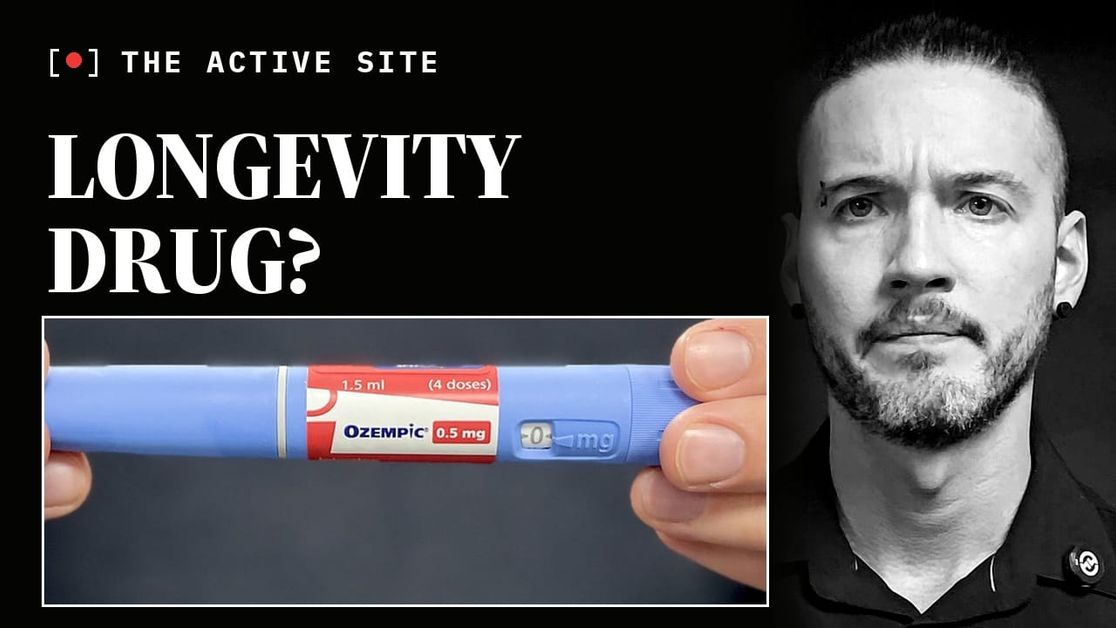
Glucagon-like peptide-1 (GLP-1) drugs like Ozempic are usually discussed as weight-loss medicines. But in October 2025, a testing company announced that semaglutide had reversed biological age by 3.1 years, and in 2026 a study in Nature reported that old female mice given the drug lived longer. The story of these drugs began with a gut hormone the body destroys in about two minutes, a lizard venom, and heart safety trials that were never meant to find a benefit. This investigation follows that evidence from the original discovery to the latest human trials to determine what GLP-1 drugs actually do, and whether their reputation as longevity drugs has been earned.
What this episode tested
Each claim the episode covers, and where the cited studies land. Numbers refer to the references below.
- Semaglutide reversed biological age by 3.1 years.Not supported
The figure came from one epigenetic clock in stored blood from 84 adults with HIV and excess body fat. It was a difference between groups, scaled up to a yearly rate from about seven months of observation. It does not mean anyone became 3.1 years younger.
Refs 10 - GLP-1 drugs can prevent heart attacks, strokes and cardiovascular deaths in type 2 diabetes.Supported
In over 9,000 people at high cardiovascular risk, about 13 in every 100 on liraglutide had one of these events over almost four years, against about 15 on placebo. An earlier trial of a related drug showed safety without fewer events, so the benefit cannot be assumed for every drug in the class.
- Semaglutide protects the heart in people with excess weight and no diabetes.Supported
SELECT followed more than 17,000 people with established heart disease for a little over three years. About 65 in every 1,000 on semaglutide had a heart attack, stroke or cardiovascular death, against about 80 on placebo.
Refs 7 - Semaglutide protects the kidneys in type 2 diabetes with kidney disease.Supported
FLOW followed 3,533 people for about three and a half years. About 187 in every 1,000 on semaglutide had kidney failure, lost at least half of kidney function, or died of kidney or cardiovascular causes, against about 232 on placebo.
Refs 8 - Semaglutide lowers deaths from any cause.Mixed
Confirmed in FLOW, where deaths fell from about 158 to 128 per 1,000. In SELECT, deaths were lower (about 43 against 52 per 1,000), but the trial's preset testing rules did not allow that difference to be formally confirmed.
- The heart benefit is independent of weight loss.Unsettled
The SELECT team reported that protection appeared within 20 weeks and concluded it was independent of weight loss. But people were sorted by weight loss after the fact, and on placebo those who lost the most weight early had the most events, so how much weight loss explains is not settled.
Refs 9 - Semaglutide slows decline in early Alzheimer's disease.Not supported
In two trials of almost 4,000 people with early, symptomatic disease, both groups worsened by a little more than two points on an 18-point scale over two years. Both ruled out the roughly 20% benefit they were designed to detect. Prevention starting years earlier was not tested.
Refs 11 - Semaglutide extends lifespan in mice.Animal only
In female mice started at 20 months of age, median lifespan rose from 742 to 834 days, about 12%. One laboratory and one sex, and no group on a matched lower-calorie diet was followed for life, so eating less cannot be ruled out as the cause.
Refs 12 - Semaglutide makes organs biologically younger.Unreviewed
A manufacturer analysis of stored blood from five trials estimated a heart age a few years lower on semaglutide, but the gap appeared within months and did not grow. Not peer-reviewed, and the authors cautioned against calling it proof of rejuvenation.
Refs 13 - People can stay on semaglutide long term.Mixed
In SELECT, about 1 in 6 on semaglutide stopped because of side effects, against about 1 in 12 on placebo. Among nearly 160,000 people in Denmark who started it for weight, about half stopped within a year.
- The weight benefit lasts after stopping.Not supported
Within a year of stopping both the drug and its lifestyle program, participants regained about two-thirds of the weight they had lost, and blood pressure returned to around its starting level. Heart attacks and deaths were not measured.
Refs 15 - Semaglutide slows human aging.Untested
No trial has tested this directly. A federally funded program plans to begin enrolling adults in their sixties next year, measuring physical and mental capacity, though it will not by itself settle whether aging has slowed.
Timestamps
- 0:00Intro
- 0:48The two-minute hormone
- 1:33The Gila monster discovery
- 2:29The heart safety scare
- 4:02Ozempic becomes a weight-loss drug
- 4:42The SELECT and FLOW trials
- 6:13Where the 3.1 years came from
- 7:48The Alzheimer's trials
- 8:56Old mice lived longer
- 10:22What happens when people stop
- 11:34What the evidence actually shows
Transcript
Lightly cleaned from the episode's transcript. Click a time to jump to that point in the video.
Show full transcript
In October 2025, a testing company claimed that semaglutide, the drug in Ozempic and Wegovy, had reversed biological age by an average of 3.1 years. If a drug could keep you stronger, sharper and independent for longer, it would change what getting older looks like, and it could give people a reason to take it for decades.
It would be easy to dismiss that as hype, but semaglutide has been tested in trials involving tens of thousands of people. Some of the strongest reasons to take the idea seriously came from trials that were never looking for them, trials run only to make sure diabetes drugs weren't harming the heart. Then, in September, a study in Nature reported that old female mice given the drug lived longer. The question is whether it can do anything like that for people.
The medicine began with a much smaller problem: helping the body handle sugar after a meal. In 1964, researchers compared what happened when people received glucose by mouth or through a vein, and taking it by mouth produced a larger insulin response. The gut was sending a signal that helped the pancreas respond to the sugar.
By 1987, groups in Boston, Copenhagen and London had identified an active form of one of those signals, a hormone called GLP-1, and shown its effect in people. It prompts insulin release mainly when blood sugar is high, which made it an attractive starting point for a diabetes drug. The obstacle is that the body clears half of natural GLP-1 within about two minutes. Making it useful as a medicine meant finding a way to keep that signal active.
In 1992, a researcher at the Veterans Affairs hospital in the Bronx isolated a substance from Gila monster venom that activates the same receptor, the docking site GLP-1 uses on cells, and lasts much longer. The following year, a group in Germany showed how an enzyme cuts the first two building blocks off human GLP-1, leaving a form that barely activates the receptor at all. Think of the front of the hormone as the tip of a key, and the enzyme as a file that grinds the tip away. The lizard's version has a different tip that resists that cut.
Chemists at Novo Nordisk took a different route and protected the human hormone itself. By 2000, they had attached fatty acids that made it bind to albumin, a carrier protein in the blood, which prolonged its action. The lizard-based version reached patients first, in 2005, and although it still needed two injections a day, a signal that disappeared within minutes could now be used to treat diabetes. The next test would be whether improving blood sugar actually made patients safer.
In 2007, an analysis of 42 trials linked a widely used diabetes pill to more heart attacks. The concern exposed a dangerous possibility: a drug could improve the number used to manage diabetes while making a major complication more likely. The next year, the FDA asked that new diabetes drugs be shown not to raise cardiovascular risk, which meant following people for heart attacks, strokes and deaths, not just measuring their blood sugar.
The human-hormone approach produced liraglutide, approved in 2010. Its attachment to albumin extended its half-life, the time needed to clear half a dose, to about 13 hours, long enough for one injection a day. The heart results started arriving in 2015, when a trial of a related GLP-1 drug established cardiovascular safety without showing a reduction in events.
In 2016, the liraglutide trial found more. Among over 9,000 participants with type 2 diabetes at high cardiovascular risk, about 13 in every 100 on the drug had a heart attack, a stroke or a cardiovascular death. On placebo, it was about 15 in every 100, over almost four years. A trial designed first to rule out added harm had found actual protection. The earlier result meant that benefit could not simply be assumed for every drug acting on this receptor, but the possibility was now real. These medicines could help prevent the events that shorten people's lives.
Semaglutide took the engineering further, combining an enzyme-resistant tip with a fatty acid that binds to albumin, and its half-life reached about a week. Approved as Ozempic in 2017, it made that sustained signal available in a weekly injection. The same signal reaches appetite, through GLP-1 receptors in brain regions involved in eating, and semaglutide reduces how much people eat. That gave a diabetes medicine a second use.
In a 2021 trial of nearly 2,000 adults with overweight or obesity but no diabetes, people on semaglutide lost about 15% of their starting weight over 68 weeks. People on placebo lost about 2%, although both groups received the same diet and physical-activity support. The drug was approved for weight loss as Wegovy that year. By then, larger trials were already asking what it could do for the heart and kidneys, and two trials of a daily semaglutide pill had begun in early Alzheimer's disease.
The heart trial, called SELECT, reported in 2023 after following more than 17,000 people with established heart disease and excess weight, but no diabetes, for a little over three years. They received semaglutide at 2.4 milligrams once a week or a placebo. About 65 in every 1,000 on semaglutide had a heart attack, a stroke or a cardiovascular death, compared with about 80 on placebo. That is 15 fewer people experiencing one of those events for every thousand treated.
Deaths from any cause were lower too, about 43 per thousand against 52. But the trial's preset testing rules did not allow that difference to be formally confirmed, so it remains a promising finding rather than a proven one.
In 2024, the kidney trial, called FLOW, reported after following 3,500 adults with type 2 diabetes and damaged kidneys for about three and a half years, on 1 milligram of semaglutide weekly or placebo. Its main measure combined kidney failure, losing at least half of kidney function, and death from kidney or cardiovascular disease. About 187 in every 1,000 on semaglutide experienced one of those outcomes, compared with about 232 on placebo. Deaths from any cause fell from about 158 per thousand to 128, and here the mortality result passed the planned statistical test.
These were people avoiding serious illness and death during a trial, and even if weight loss contributed to the benefit, that would not make it less valuable. What these results could not establish was whether the drug was also changing aging itself.
In 2025, researchers tried to get closer to that question by returning to stored blood from a completed semaglutide trial. The participants were adults with HIV and excess body fat, and the trial had not been designed to study aging. Blood from 84 people was tested with epigenetic clocks, formulas that use chemical tags on DNA to estimate age or the risk of death. Several scores came out lower on semaglutide than on placebo. That was an interesting signal, but a lower score does not establish that a person will stay healthy longer.
This is where the 3.1 years came from. TruDiagnostic, the testing company behind that October claim, had scientists on the study. The number described a difference between the groups on one clock, scaled up to a yearly rate from about seven months of observation. It did not mean the people taking the drug had become 3.1 years younger. A statistical result had acquired a much more dramatic meaning in the public claim.
The heart trial raised a question of its own: how much of its protection came from losing weight. That same month, the SELECT trial team reported that the protection appeared within 20 weeks and concluded that it was independent of weight loss. But the participants had been randomly assigned to the drug or placebo, not to lose a particular amount of weight, so sorting them afterward by weight loss could introduce other differences.
In the placebo group, those who lost the most weight early had the highest rate of heart attacks, strokes and cardiovascular deaths, and illness-related weight loss was one possible explanation. The heart benefit was real, but how much of it weight loss explained was less settled. A benefit beyond weight loss would still need its own explanation, and it would not automatically mean slower aging.
Late in 2025, the Alzheimer's trials reported, offering something an aging clock could not: a direct test of memory and daily function. Across the two trials, almost 4,000 people with early, symptomatic Alzheimer's disease, with an average age of 72, took a daily semaglutide pill or placebo for two years. Decline was tracked on an 18-point scale covering memory, judgment and everyday abilities.
Both groups worsened by a little more than two points. Neither trial demonstrated slower clinical decline, and both ruled out the roughly 20% benefit they were designed to detect. A blood marker of inflammation fell by about a quarter to a third compared with placebo, without a demonstrated benefit in how these patients functioned.
The heart and kidney results could not simply be extended to every organ or disease. But these patients already had symptoms, so the trials did not test whether starting years earlier could prevent Alzheimer's, and they did not settle the broader aging question.
During 2026, the evidence turned more directly to aging. In May, the blood-clock analysis passed peer review, still based on the same 84 people, so publication did add scrutiny, but not a second group of participants. Then, in September, a study in Nature from a team at the University of California, Berkeley measured something much more direct. Female mice started daily semaglutide at 20 months of age, late in a mouse's life, and were followed until they died.
Half the untreated mice had died by 742 days of age. The treated mice reached that point at 834 days, about three months later, a gain of roughly 12% in median lifespan. This was a lifespan result, not an age estimate from blood, but it came from one laboratory and one sex, and whether the lifespan experiment was repeated remains unclear.
Separate groups of treated mice performed better on tests of strength, endurance and memory, and in one 24-hour measurement, they also ate about a quarter less. No group on a diet matched to that lower intake was followed for life, so the experiment could not separate the contribution of eating less from other effects of the drug. The longer lives still matter, because they make the possibility worth pursuing, even though they do not show that people will gain the same benefit.
Later that month, scientists at Novo Nordisk, which makes semaglutide, posted an unreviewed analysis of stored blood from five trials, using proteins to estimate the ages of organs without directly testing how those organs worked. The estimated age of the heart came out a few years lower on semaglutide, but the gap appeared within months without growing later. One possible explanation is a change in a risk signal rather than slower aging. The data could not settle that distinction, and the authors explicitly cautioned against calling the results proof of biological rejuvenation.
A promising aging result also has to survive a practical test: whether people can stay on the treatment. In the SELECT trial, about one in six people on semaglutide stopped because of side effects, compared with about one in 12 on placebo. A 2026 study of nearly 160,000 people in Denmark who started semaglutide for weight found that about half stopped within a year, for reasons the discontinuation figure alone does not explain.
Earlier withdrawal research gives us a partial view of what happens next. A follow-up published in 2022 tracked a subgroup from the weight-loss trial after both the drug and its lifestyle program ended. Within a year, participants regained about two-thirds of the weight they had lost, and their blood pressure returned to around its starting level. Heart attacks and deaths were not measured, so this does not tell us whether protection against them disappears too.
Body scans in a separate subgroup of the original trial measured how much fat and lean tissue people lost. Roughly a third to two-fifths of that combined loss was lean tissue, depending on the analysis. That measurement includes water and tissues other than muscle, so on its own it cannot tell us how someone's strength will hold up over decades. For a treatment intended to preserve independence, being able to continue it and maintain physical function are part of the benefit we need to establish.
There is a credible case for calling semaglutide a longevity drug, provided we are clear about what has been demonstrated. In the higher-risk people studied, it has prevented serious disease, and in the kidney trial it reduced deaths during follow-up, which is meaningful evidence for helping people live longer. My view is that preventing the diseases that cut lives short belongs in longevity medicine, whether the benefit comes through weight loss or other pathways.
The stronger claim, that semaglutide slows human aging itself, remains open, although the mouse lifespan result gives it substance and the blood studies offer leads to investigate. Neither establishes that people taking it will age more slowly, and the Alzheimer's trials show why improved biological measurements cannot stand in for preserved function.
Testing preserved function directly is the next step worth being excited about. A federally funded program also plans to begin enrolling adults in their 60s next year, testing semaglutide and two other drugs in separate groups against placebo and measuring physical and mental capacity. That gets closer to the promise people actually care about, keeping the ability to live their lives, although it will not by itself settle whether human aging has slowed.
The 3.1-year claim asks us to treat a change in a test as years of youth. The more compelling possibility is years of life people can actually use. What these medicines have already achieved is reason enough to find out how far that can go. That's it for today's episode, everyone. Until next time, stay healthy.
References
- Eng J, et al. Isolation and characterization of exendin-4, an exendin-3 analogue, from Heloderma suspectum venom. J Biol Chem. 1992. PMID 1313797
- Lau J, et al. Discovery of the once-weekly glucagon-like peptide-1 (GLP-1) analogue semaglutide. J Med Chem. 2015. PMID 26308095
- Nissen SE, Wolski K. Effect of rosiglitazone on the risk of myocardial infarction and death from cardiovascular causes. N Engl J Med. 2007. PMID 17517853
- Pfeffer MA, et al. Lixisenatide in patients with type 2 diabetes and acute coronary syndrome (ELIXA). N Engl J Med. 2015. PMID 26630143
- Marso SP, et al. Liraglutide and cardiovascular outcomes in type 2 diabetes (LEADER). N Engl J Med. 2016. PMID 27295427
- Wilding JPH, et al. Once-weekly semaglutide in adults with overweight or obesity (STEP 1). N Engl J Med. 2021. PMID 33567185
- Lincoff AM, et al. Semaglutide and cardiovascular outcomes in obesity without diabetes (SELECT). N Engl J Med. 2023. PMID 37952131
- Perkovic V, et al. Effects of semaglutide on chronic kidney disease in patients with type 2 diabetes (FLOW). N Engl J Med. 2024. PMID 38785209
- Deanfield J, et al. Semaglutide and cardiovascular outcomes by baseline and changes in adiposity measurements (SELECT). Lancet. 2025. PMID 41138739
- Corley MJ, et al. Semaglutide slows epigenetic aging in a randomized trial of HIV-associated lipohypertrophy. Nat Commun. 2026. PMID 42156721
- Cummings JL, et al. Oral semaglutide in early-stage symptomatic Alzheimer's disease (evoke and evoke+). Lancet. 2026. PMID 41865758
- Feng Y, et al. Late-life semaglutide treatment slows ageing and extends lifespan in female mice. Nature. 2026. PMID 42686906
- Dermit M, et al. Semaglutide reduces proteomic organ-specific biological age across randomized clinical trials. Research Square preprint. 2026. DOI 10.21203/rs.3.rs-11082091/v1
- Mailhac A, et al. Discontinuation of semaglutide therapy for obesity management. JAMA Netw Open. 2026. PMID 42664011
- Wilding JPH, et al. Weight regain and cardiometabolic effects after withdrawal of semaglutide: the STEP 1 trial extension. Diabetes Obes Metab. 2022. PMID 35441470
Header photo: Chemist4U, CC BY-SA 2.0