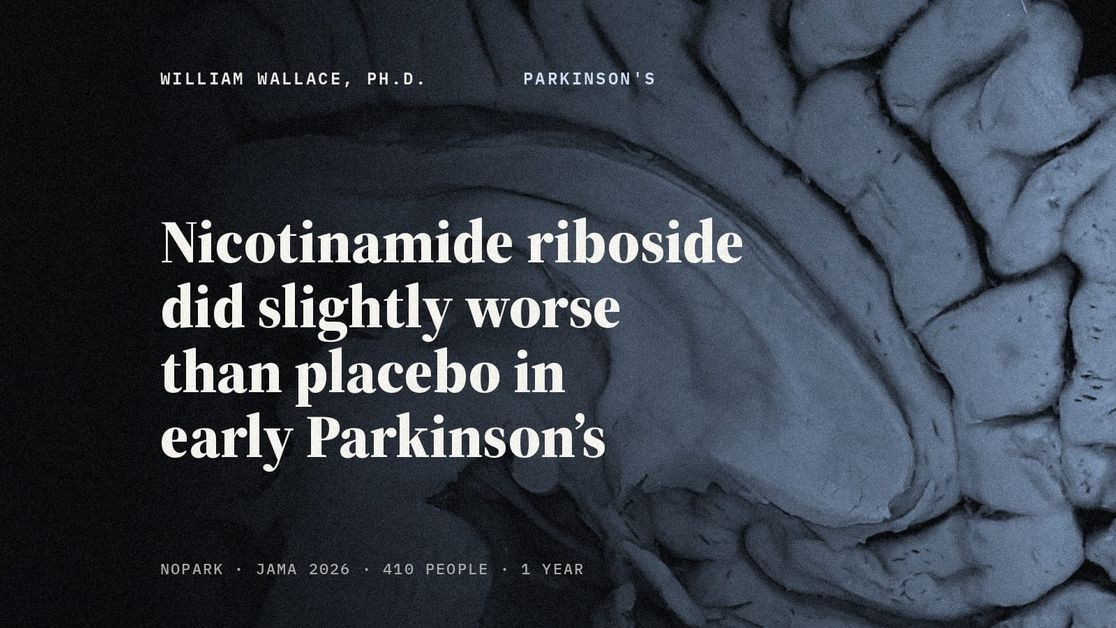
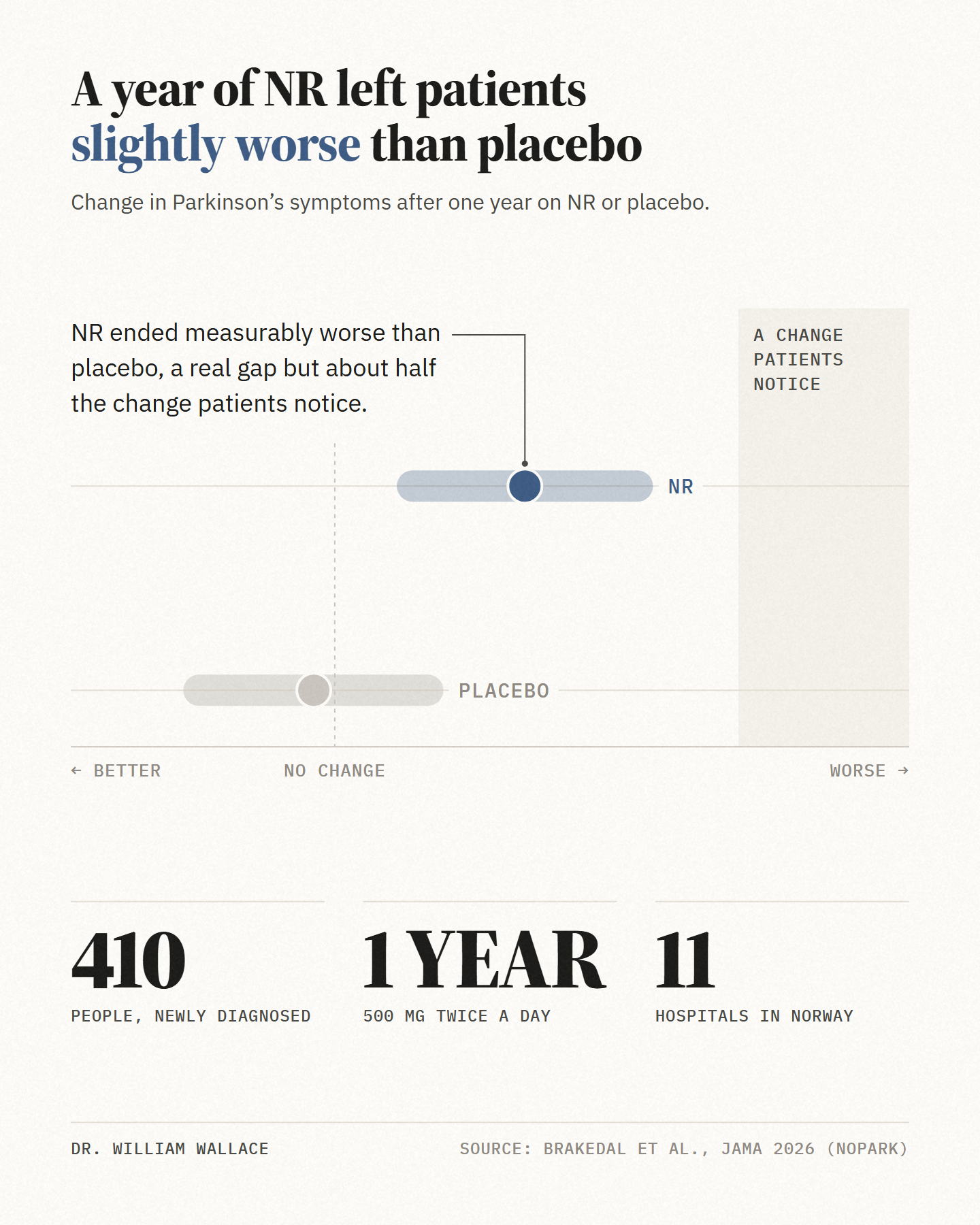
Nicotinamide riboside, a popular supplement sold to raise NAD+, left people with early Parkinson's slightly worse than placebo after a year. In NOPARK, the largest and longest Parkinson's trial of nicotinamide riboside so far, published in JAMA, a year of nicotinamide riboside did not improve symptoms, and people taking it ended slightly but measurably worse than on placebo, by less than patients would notice. The gap was about half the size of a change patients can notice, so it was small, but it pointed the wrong way, and the trial was not designed to show harm.
NAD+ is a molecule cells need to make energy, and nicotinamide riboside is a building block the body turns into it.
Who was in the trial
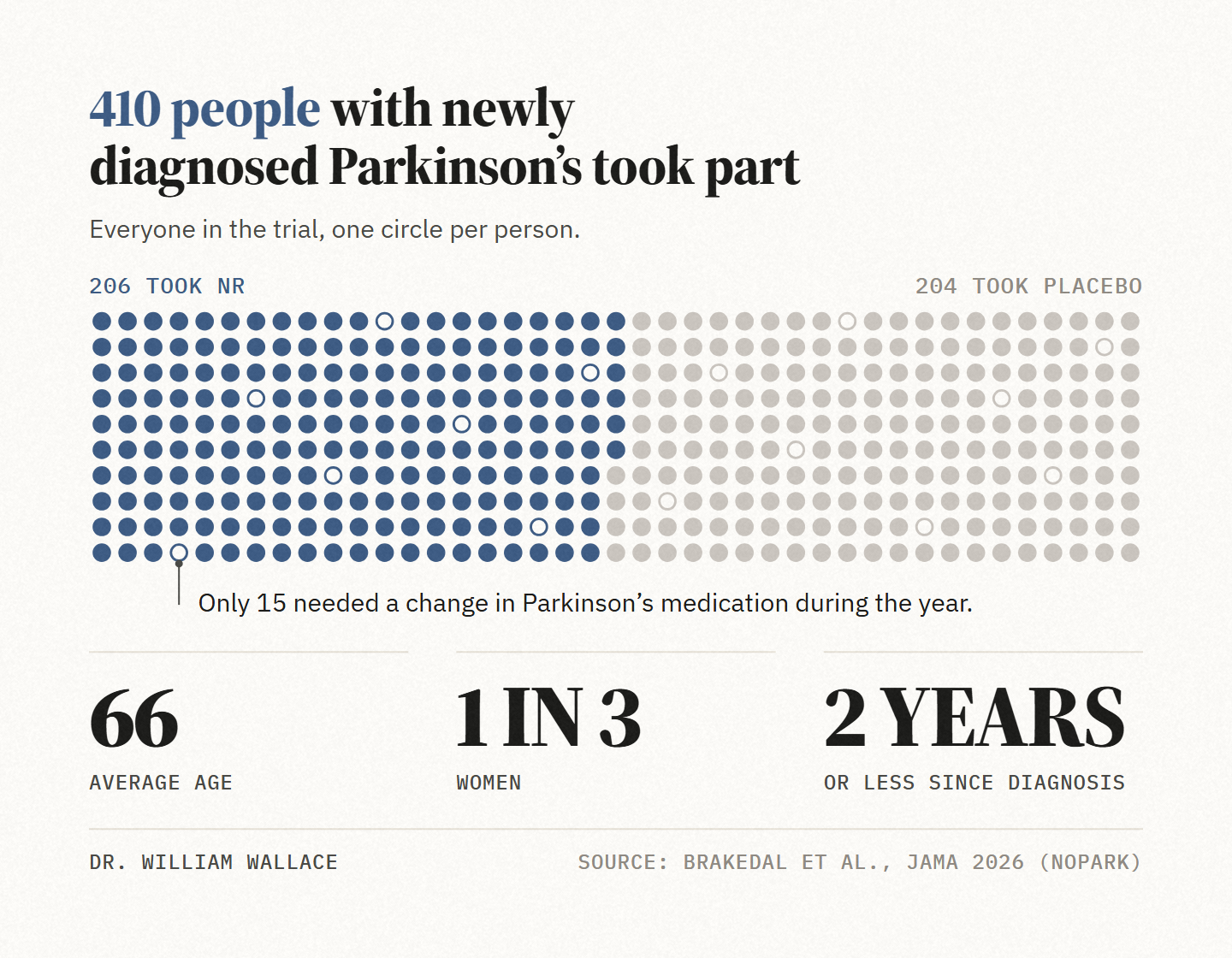
The trial enrolled 410 people at 11 centers in Norway, all diagnosed within the previous two years and still mildly to moderately affected. Their average age was about 66, and about a third were women. Everyone was already on stable Parkinson's medication, and only 15 people needed a change during the year. Half took 500 mg of nicotinamide riboside twice a day and half took an identical placebo for one year, and neither patients nor doctors knew who got which.
What it found
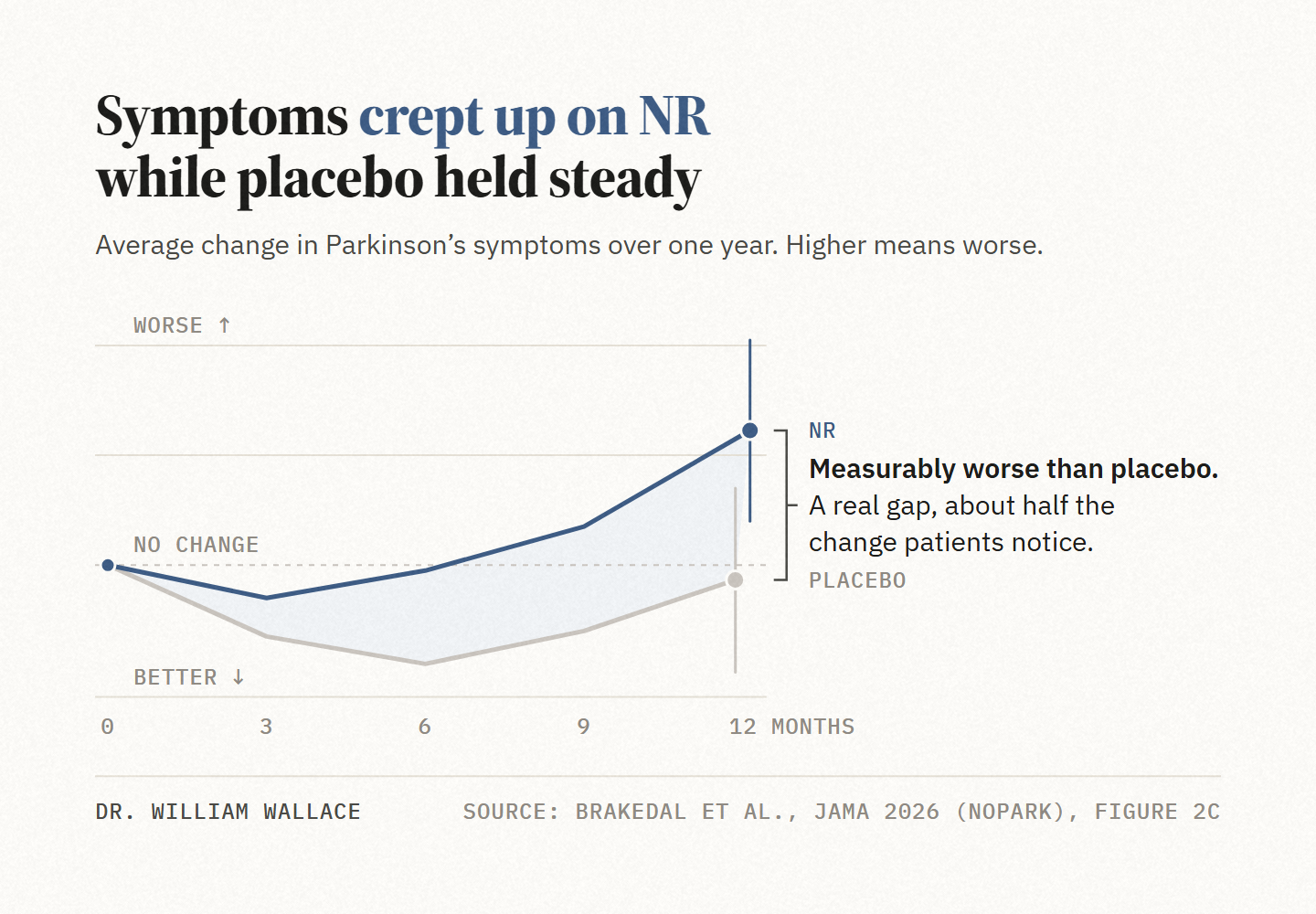
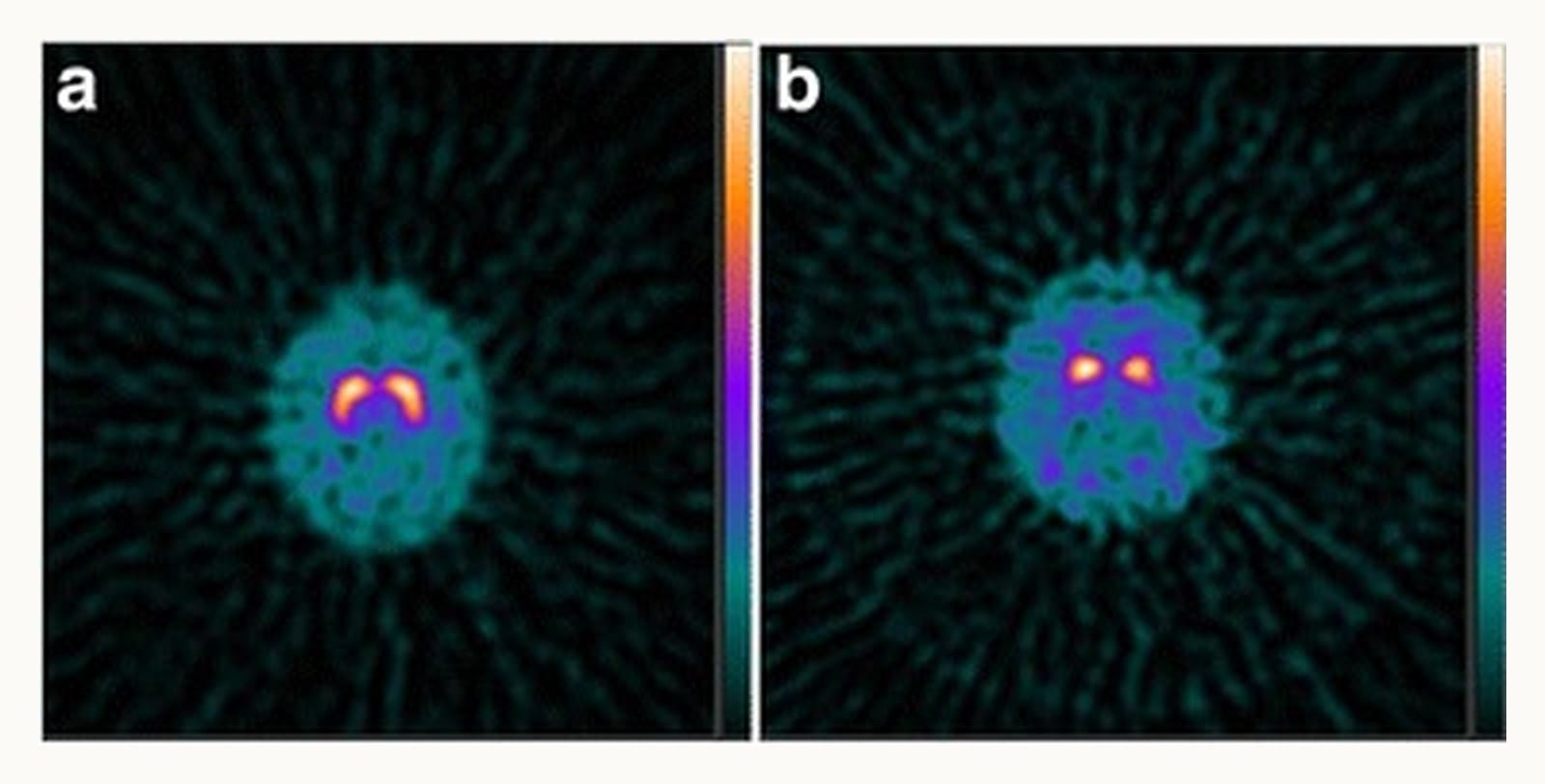
Over the year, symptoms got slightly worse on nicotinamide riboside and held about steady on placebo. The difference was small, about half of what patients tend to notice, but it was not in nicotinamide riboside's favor. A brain scan of dopamine nerve endings showed no difference, and one measure, non-movement symptoms such as mood and thinking, was slightly worse on nicotinamide riboside.
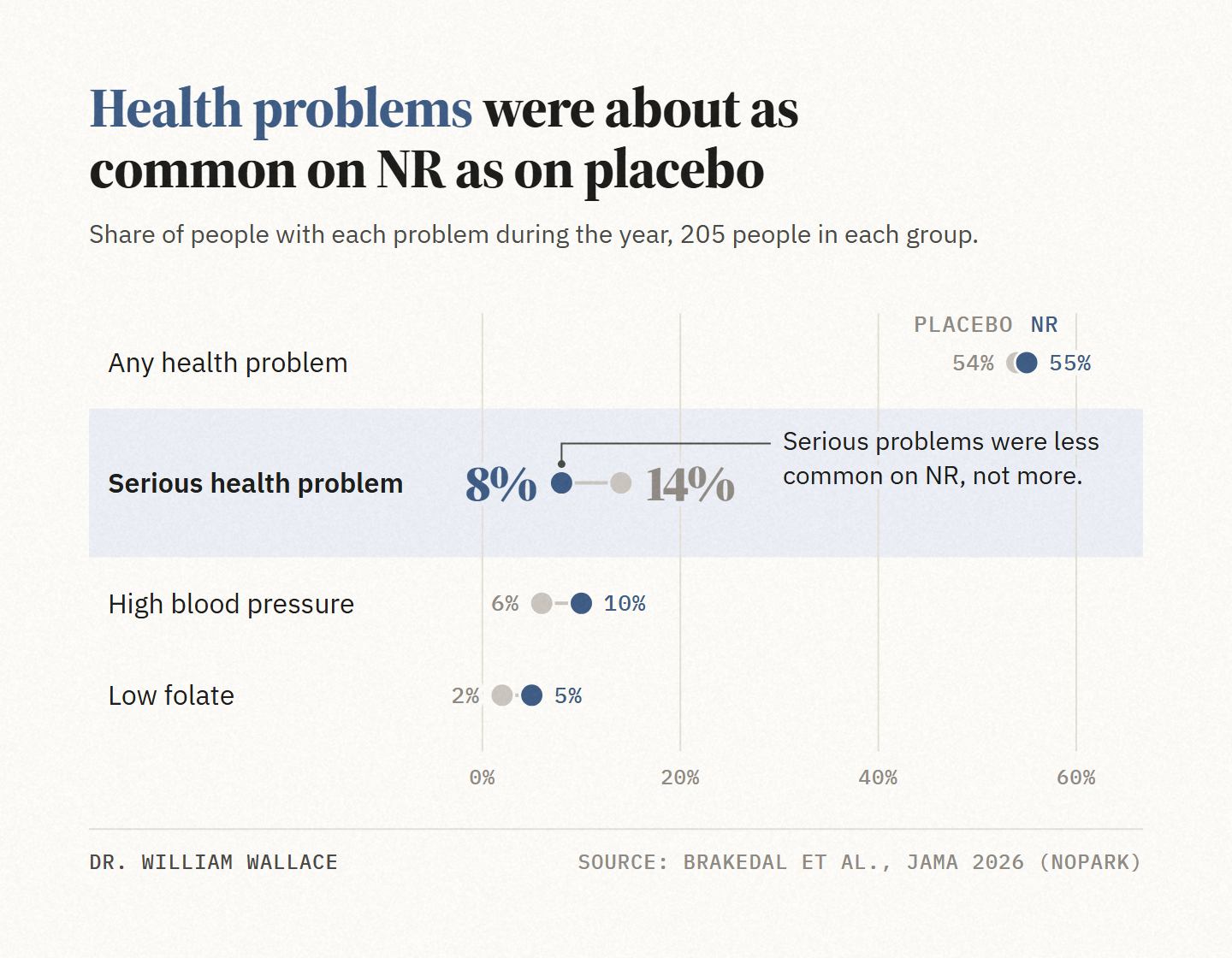
Side effects were about as common on nicotinamide riboside as on placebo (55% vs 54% of people). High blood pressure was the most frequent (10% vs 6%; the paper did not test whether these differences were real), and serious events were less common on nicotinamide riboside (8% vs 14%).
The authors concluded that the findings "do not support nicotinamide riboside as a disease-modifying treatment for Parkinson disease."
Why researchers expected it to work
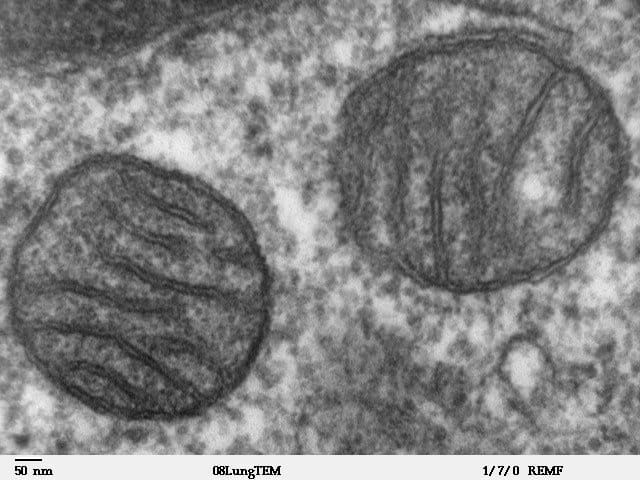
Mitochondria, the parts of the cell that produce energy, falter in Parkinson's. In a 2018 study, nicotinamide riboside improved energy production in nerve cells grown from patients with a genetic form of the disease and protected dopamine neurons in fruit flies. A 2024 brain tissue study found that about one in four people with the common form of Parkinson's have a widespread energy defect in their neurons, the kind of problem NAD+ was meant to help. Findings like these justify a trial, but they cannot show whether people will benefit.
How this trial differs from the earlier ones
The same Bergen research group ran the two earlier nicotinamide riboside trials in Parkinson's. NADPARK (2022) treated 30 people for 30 days and hinted at mild improvement in a subgroup. NR-SAFE (2023) gave a higher dose to 20 people for four weeks, and its improvement also tracked how recently people had taken their regular medication.
NOPARK was more than ten times larger and lasted a year instead of a month. A one-month trial cannot show an effect on a disease that progresses over years, and a hint in a small subgroup often fades in a trial large enough to test it. A small 2021 trial of low-dose niacin, another NAD+ building block, also did not separate from placebo in its blinded phase.
The strongest case that nicotinamide riboside is not finished
NOPARK tested one dose, one form and one stage of disease. A higher-dose trial, N-DOSE, had posted no results as of Oct 19, 2026. NOPARK did not select patients with the energy defect, and regular medication may have masked part of any effect. None of this is evidence that nicotinamide riboside works, and the result pointed the wrong way.
Funding and conflicts
Norwegian public and foundation funders paid for the trial. ChromaDex, a Niagen Bioscience company that makes nicotinamide riboside, supplied the capsules, and the paper states the funders had no role in the design, analysis or decision to publish. Two of the investigators hold patents on nicotinamide riboside for Parkinson's that are licensed to Niagen Bioscience, and one of them also reported personal fees from the company.
What the evidence supports
For people early in Parkinson's, a year of nicotinamide riboside did not improve symptoms. The trial does not show that nicotinamide riboside harms people with Parkinson's, and it says nothing about healthy people taking nicotinamide riboside. In two small memory trials, one in 2024 and one in 2026, nicotinamide riboside raised blood NAD+ without improving memory. Raising a marker and helping patients are different results.
If you have Parkinson's and take nicotinamide riboside, talk with your neurologist before starting or stopping it.
A note on the measures: the trial scored symptoms with the standard Parkinson's rating scale used in clinical research, plus a dopamine brain scan and a non-movement symptom questionnaire. Full details are in the paper and the trial registry.
[MY INTEREST, William to rewrite or cut: My interest is that a large, year-long trial designed to find a benefit found none, and that should count for more than the small, short studies that raised hopes.]
This article is part of Field Notes: the newest research in medicine, health tech, nutrition and supplements, and what it means for you. Get it every week
Sources
- Brakedal B, Skeie GO, Derad C, et al. Nicotinamide riboside for patients with early-stage Parkinson disease: the NOPARK randomized clinical trial. JAMA. Published online October 8, 2026. https://doi.org/10.1001/jama.2026.18828 (PubMed 42848371)
- ClinicalTrials.gov. A Randomized Controlled Trial of Nicotinamide Riboside Supplementation in Early Parkinson's Disease (NOPARK), NCT03568968, record and statistical analysis plan V1.0. https://clinicaltrials.gov/study/NCT03568968
- Brakedal B, Dölle C, Riemer F, et al. The NADPARK study: a randomized phase I trial of nicotinamide riboside supplementation in Parkinson's disease. Cell Metab. 2022;34(3):396-407.e6. https://doi.org/10.1016/j.cmet.2022.02.001 (PubMed 35235774)
- Berven H, Kverneng S, Sheard E, et al. NR-SAFE: a randomized, double-blind safety trial of high dose nicotinamide riboside in Parkinson's disease. Nat Commun. 2023;14(1):7793. https://doi.org/10.1038/s41467-023-43514-6 (PubMed 38016950)
- Schöndorf DC, Ivanyuk D, Baden P, et al. The NAD+ precursor nicotinamide riboside rescues mitochondrial defects and neuronal loss in iPSC and fly models of Parkinson's disease. Cell Rep. 2018;23(10):2976-2988. https://doi.org/10.1016/j.celrep.2018.05.009 (PubMed 29874584)
- Flønes IH, et al. Mitochondrial complex I deficiency stratifies idiopathic Parkinson's disease. Nat Commun. 2024. https://doi.org/10.1038/s41467-024-47867-4 (PubMed 38684731)
- Wakade C, et al. Low-dose niacin supplementation improves motor function in US veterans with Parkinson's disease: a single-center, randomized, placebo-controlled trial. Biomedicines. 2021. https://doi.org/10.3390/biomedicines9121881 (PubMed 34944695)
- Orr ME, et al. A randomized placebo-controlled trial of nicotinamide riboside in older adults with mild cognitive impairment. GeroScience. 2024. https://doi.org/10.1007/s11357-023-00999-9 (PubMed 37994989)
- Martens CR, et al. A phase II randomized controlled pilot study of nicotinamide riboside supplementation in older adults with amnestic mild cognitive impairment. Alzheimers Dement. 2026. https://doi.org/10.1002/alz.71605 (PubMed 42478598)
- ClinicalTrials.gov. N-DOSE: A Dose Optimization Trial of Nicotinamide Riboside in Parkinson's Disease, NCT05589766. https://clinicaltrials.gov/study/NCT05589766