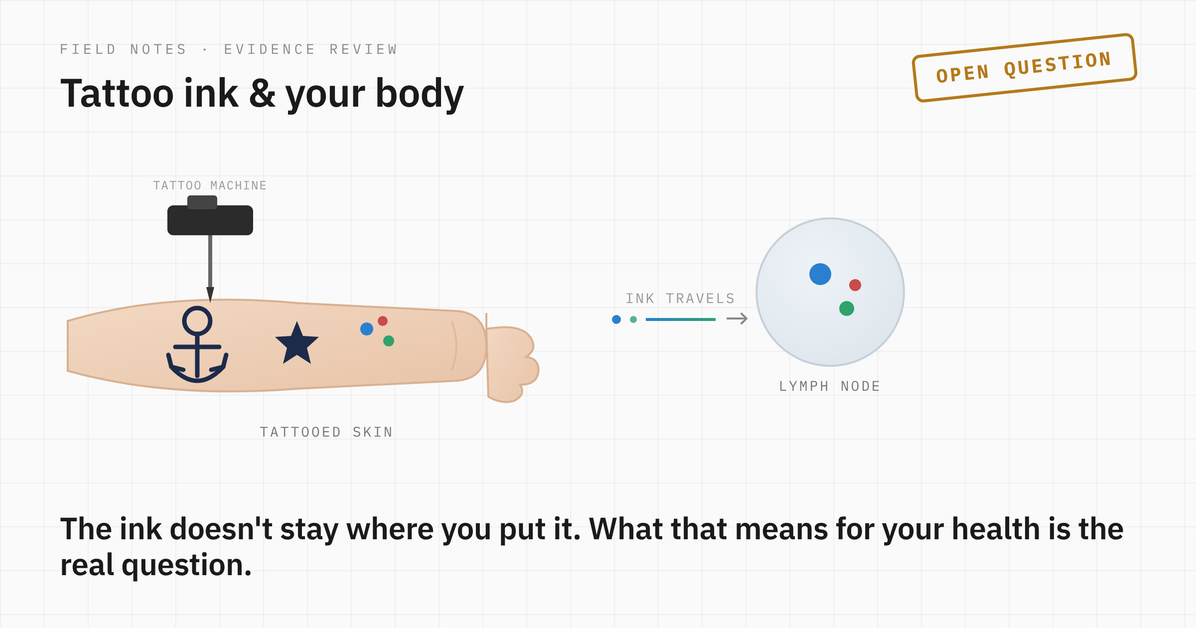

Ask most people what becomes of a tattoo once it heals, and they describe something finished – i.e., a permanent mark, sealed in the skin, chemically done with the body. The pigment is inert decoration, but doesn’t influence physiology. This is the reassuring version, and it is wrong in a specific, checkable way.
Pathologists have known for a long time. Operating near a lymph node, an organ that helps sort what belongs in the body from what does not, they would find it stained the color of a tattoo inked somewhere else entirely.1 The ink had left the skin, carried inward to a place no needle ever reached.
That single observation splits into two questions, and they are not the same question. What is the body doing to the ink once it arrives? And does any of it actually harm the person carrying it?
The Handoff Problem
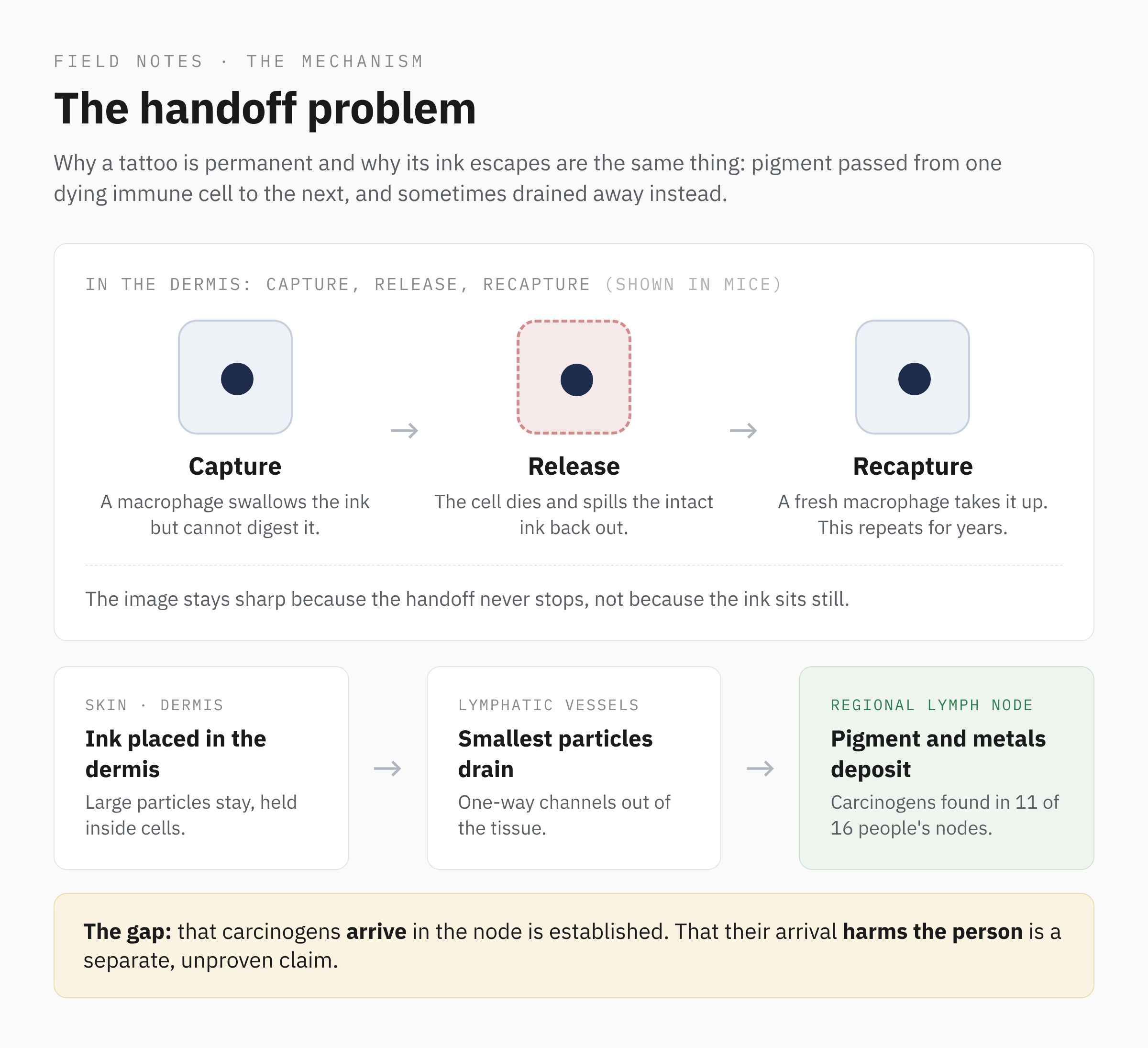
The thing that makes a tattoo permanent and the thing that lets its ink escape turn out to be one mechanism. When pigment is deposited in the dermis, the body reads it as foreign and sends in macrophages (immune cells that engulf what does not belong). They swallow the pigment but cannot break it down, so it stays lodged inside them, intact.
What happens next was shown directly in mice. In 2018, a team imaging living tissue watched a pigment-loaded macrophage die and spill its cargo, only for a neighboring macrophage to immediately re-engulf the same particles – i.e., “capture, release, recapture”, the load handed from one dying cell to the next in almost the same spot.2 The mark on the skin holds not because the ink is stable but because the handoff never stops.
A relay that runs for years across millions of cells is not sealed. Each time a particle is dropped and re-caught, it may instead drain into the lymphatic vessels threaded through the skin, and those channels end at the lymph nodes (usually the nearest one to where the tattoo ink was placed - the “draining lymph node”). Size, in part, decides which. In human cadaver tissue examined under a synchrotron, pigment spanned a wide range of particle sizes, and it was the smallest particles that preferentially reached the nodes.1
The ink does not travel alone. The carcinogens measured in the ink make the same trip. For instance, polycyclic aromatic hydrocarbons, concentrated in black pigment were found deposited in the regional lymph nodes of 11 of 16 tattooed people.3
This is why the fear is biologically reasonable rather than fringe. Known carcinogens are demonstrably carried out of the skin and stored in an organ, for years. However, there is a gap between what has been shown and what is feared. That carcinogens arrive in the node is established. That their arrival harms the person and starts a cancer, damages the organ, etc. is a separate claim, and it does not follow automatically from the first. Everything that matters lives in that gap.
What the studies actually found
Until 2024, the honest answer to "do tattoos raise your cancer risk?" was that almost no one had done the study to find out. Then, over about two years, several teams did. They did not agree with each other.
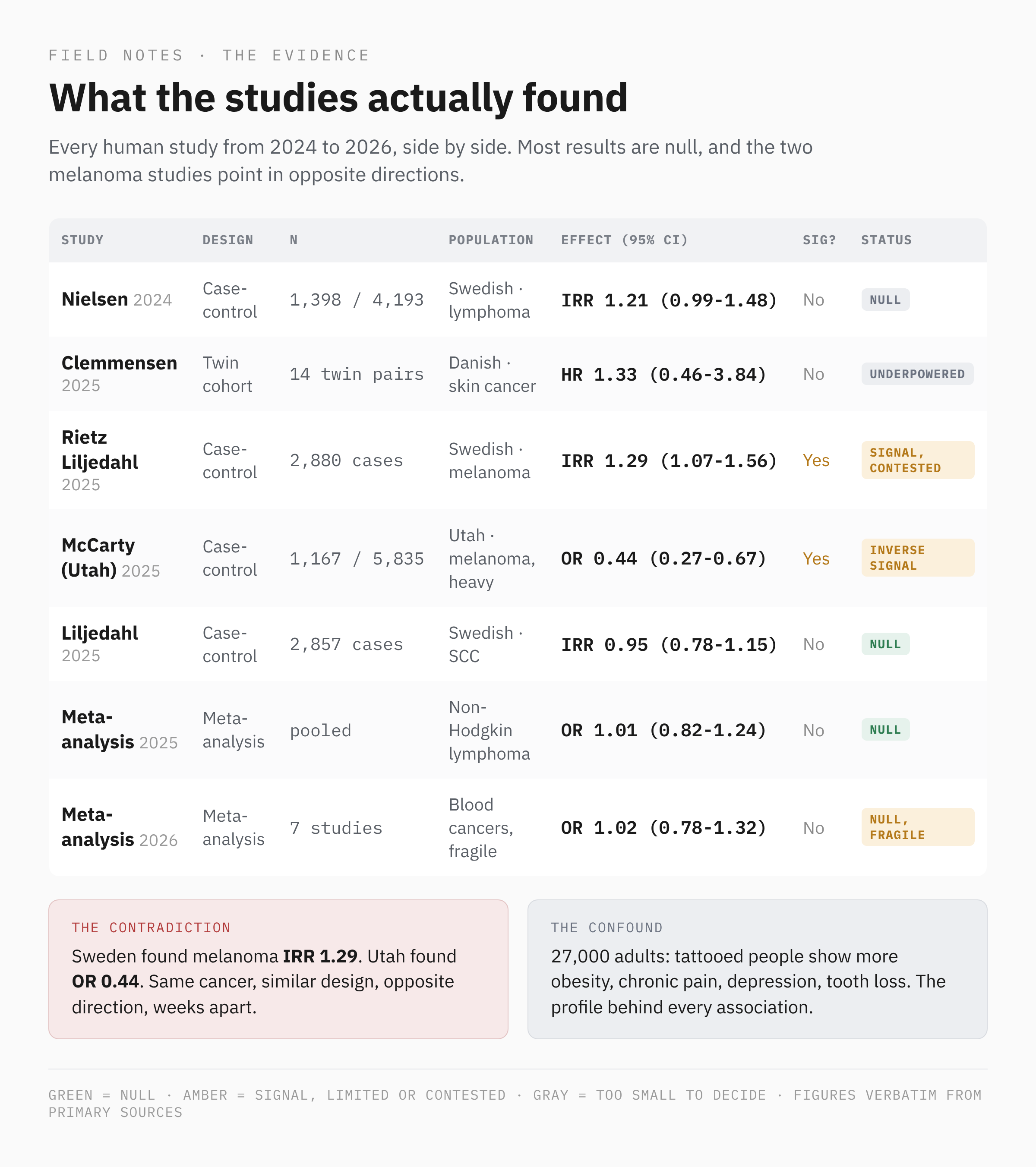
Start with lymphoma, the cancer most often linked to tattoos in the news. A Swedish study compared 1,398 people with lymphoma against 4,193 people without it. Tattooed people had a 21 percent higher rate (an incidence rate ratio of 1.21). But the margin of error ran from 0.99 to 1.48, and because that range dips just below 1.0, the result could not be separated from pure chance.4 There was no sign that more tattooing meant more risk. Oddly, the strongest signal showed up in the first two years after someone's first tattoo (a ratio of 1.81, range 1.03 to 3.20), which is backwards for a cancer that takes a long time to develop. That pattern usually means the tattoo led to more medical attention, not more cancer.4
A Danish study of twins looked at this more carefully. Counting people individually, it found a higher rate of skin cancer (a hazard ratio of 1.62, range 1.08 to 2.41) and a higher rate of lymphoma among people with large tattoos (2.73, range 1.33 to 5.60).5 But its best test compared twins where one had a tattoo and the other did not, which cancels out shared genetics and upbringing. That comparison rested on only 14 twin pairs, and the result (a ratio of 1.33, range 0.46 to 3.84) was so wide it was consistent with harm, with no effect, and even with protection, all at the same time.5 That is not evidence of harm. It is a study too small to give an answer.
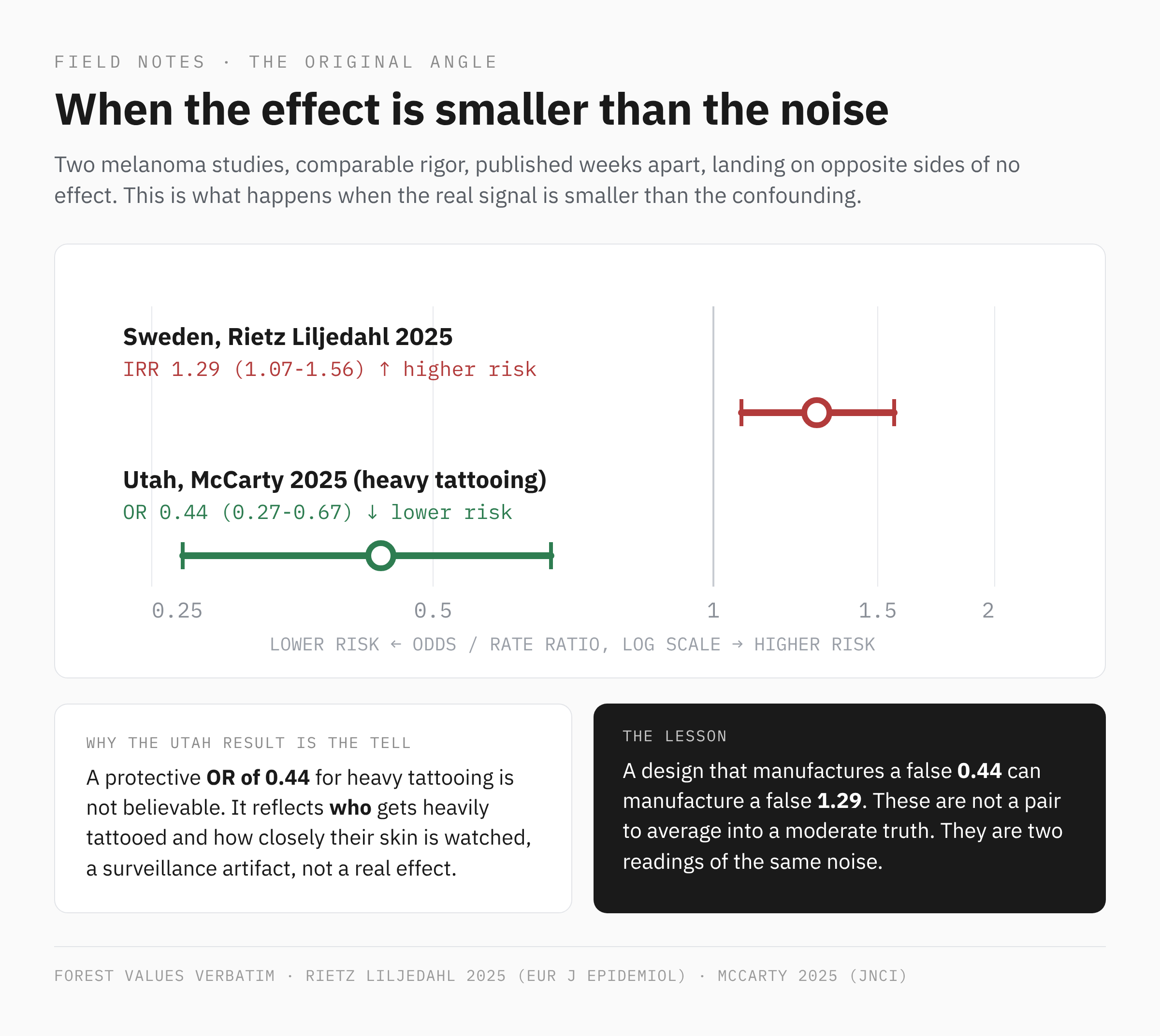
Melanoma, the most serious skin cancer, is where the disagreement became obvious. A Swedish study of 2,880 melanoma patients found a real link (a ratio of 1.29, range 1.07 to 1.56), though the authors were careful to say this did not prove tattoos cause melanoma. Other scientists have since formally challenged the finding in print.6 Just weeks later, a study from Utah looking at 1,167 melanoma patients and 5,835 people without it found the opposite. There, heavier tattooing was linked to lower risk: people with four or more tattoo sessions had a bit under half the risk (an odds ratio of 0.44, range 0.27 to 0.67), and people with three or more large tattoos had about a quarter of the risk (0.26, range 0.10 to 0.54).7 Same cancer, similar quality studies, and opposite conclusions.
The studies that found nothing deserve just as much attention, because they are the majority. The same Swedish group that saw a melanoma signal found no link at all to the most common skin cancer, squamous cell carcinoma (a ratio of 0.95, range 0.78 to 1.15).8 A review that pooled together the lymphoma studies came out flat (an odds ratio of 1.01, range 0.82 to 1.24).9 A 2026 review combining seven studies and 140,841 people found no real link to blood cancers (1.02, range 0.78 to 1.32) and none to skin cancer (0.92). And here is the telling part: removing just one study from that pool was enough to tip the result into a significant 1.20, which means the whole signal depended on a single dataset.10
One more study helps explain why all of this is so hard to read. In 2026, researchers looked at about 27,000 adults and found that tattooed people are simply different in ways that have nothing to do with ink. As a group they had higher rates of obesity, chronic pain, depression, and, fun fact, tooth loss.11 Those differences are exactly the kind of thing that can create a fake link between tattoos and cancer, and most of these studies could not fully account for them.
Why two good studies can disagree
The Swedish and Utah melanoma studies are the real lesson here, and the lesson is about how research works, not about tattoos. Same question, similar quality, opposite answers, published within weeks of each other. This is not a scandal. It is exactly what happens when the real effect, if there even is one, is small, and the messy differences between people are large.
When the link you are hunting for is this weak, it is smaller than the built-in biases of the data itself. Tattooed and untattooed people are not alike. They differ in how much sun they get, how closely their skin is checked by doctors, their weight, whether they smoke, and how much they drink. The study of 27,000 adults showed just how real those differences are.11 Depending on which way those differences tilt in a given group of people, the result can land on either side of "no effect."
The Utah result gives the game away. A finding that heavy tattooing cuts melanoma risk by more than half is not believable. Nobody thinks getting four tattoos protects you from cancer.7 If that were true, then yours truly would be entirely impervious to cancer. Far more likely, heavily tattooed people are watched more closely, or differ in some other way that shows up as lower risk. And if a study can accidentally produce a fake protective result like that, then it can just as easily produce a fake harmful result like the Swedish one. The two findings should not be averaged into a moderate middle-ground truth. They are two different readings of the same background noise.
The pooled review already hinted at this. Pull out one study and the answer flips from "no effect" to "significant." When the evidence is that shaky, the right summary is not "a little harmful" or "a little protective." It is that if there is any real effect at all, it is still too small to see through the noise.

What we know, and what nobody has measured yet
No new study settles this. What we can do is be honest about the strength of what we already have.
One thing is solid. Tattoo ink moves from the skin to the lymph nodes, and the smallest particles, along with the cancer-linked chemicals riding with them, build up there and stay for years. This has been seen directly in human tissue and is not really in dispute.1,3
A second finding is reassuring, and it pushes back on the scariest version of the tattoo story. The ink does not seem to spread throughout the body. A study in pigs found ink building up in the nearby lymph nodes but no meaningful amount reaching the liver, spleen, kidneys, or brain.12 In people, the dissolvable parts of the ink enter the bloodstream and leave the body in urine within a day, and the skin appears to break some of these compounds down into safer forms.13 The ink reaches the node, but it does not appear to seed the rest of the organs.
What is not settled is the one thing everyone wants to know: does any of this cause cancer? The human evidence is mixed, mostly shows no link, openly contradicts itself on melanoma, and falls apart when you remove a single study. There are real warning signs at the biological level, but they stop short of actual cancer in actual people. Lasting inflammation in the drain-side lymph node has been shown in mice.14 And when a laser hits one common pigment, it releases a chemical called 3,3-dichlorobenzidine that damages DNA in human cells grown in a dish.15 Both are believable routes to harm. Neither is a measured case of cancer in a living person.
So if you are trying to decide what to make of all this, the ink really does travel, it does not appear to spread through your whole body, and the cancer question is genuinely open. It has not been quietly answered yes, and it has not been quietly answered no.
The study that could actually settle it has not been done yet. It would need to follow a very large group of people for decades, recording what was in their ink, how much they got, and how much of their body was covered, while also tracking their sun exposure, weight, smoking, and drinking from the start. Two big European research projects, called Constances and NAKO, together include around 30,000 tattooed people and come closest to this, but they will not be ready to give answers for years.16 Until then, the honest answer to "does tattoo ink cause cancer?" is that we have only just started looking, and the first look came back blurry..
References
1. Schreiver, et al. Synchrotron-based ν-XRF mapping and μ-FTIR microscopy enable to look into the fate and effects of tattoo pigments in human skin. Sci Rep. 2017;7:11395. doi:10.1038/s41598-017-11721-z
2. Baranska, et al. Unveiling skin macrophage dynamics explains both tattoo persistence and strenuous removal. J Exp Med. 2018;215(4):1115–1133. doi:10.1084/jem.20171608
3. Lehner, et al. Black Tattoos Entail Substantial Uptake of Genotoxicpolycyclic Aromatic Hydrocarbons (PAH) in Human Skin and Regional Lymph Nodes. PLoS One. 2014;9(3):e92787. doi:10.1371/journal.pone.0092787
4. Nielsen, et al. Tattoos as a risk factor for malignant lymphoma: a population-based case–control study. EClinicalMedicine. 2024;72:102649. doi:10.1016/j.eclinm.2024.102649
5. Clemmensen, et al. Tattoo ink exposure is associated with lymphoma and skin cancers – a Danish study of twins. BMC Public Health. 2025;25:170. doi:10.1186/s12889-025-21413-3
6. Rietz Liljedahl, et al. Does tattoo exposure increase the risk of cutaneous melanoma? A population-based case-control study. Eur J Epidemiol. 2025;40(12):1441–1453. doi:10.1007/s10654-025-01326-6
7. McCarty, et al. Tattooing and risk of melanoma: a population-based case-control study in Utah. J Natl Cancer Inst. 2025;117(12):2495–2504. doi:10.1093/jnci/djaf235
8. Liljedahl, et al. Tattoos and cutaneous squamous cell carcinoma: a population-based case-control study. Eur J Epidemiol. 2025;40(4):451–461. doi:10.1007/s10654-025-01230-z
9. McConnell, et al. Investigating the potential association between tattoos and lymphoma: an exploratory systematic review and meta-analysis. EClinicalMedicine. 2025;103563. doi:10.1016/j.eclinm.2025.103563
10. Tudella, et al. Is tattooing associated with an increased risk of cancer? A systematic review and meta-analysis. Clin Transl Oncol. 2026. doi:10.1007/s12094-026-04388-4
11. McCarty, et al. Associations Between Tattooing and Health Status: A Population-Based Cross-Sectional Study of Adults in Utah, 2020-2022. Public Health Rep. 2026. doi:10.1177/00333549261445868
12. Cambiaso-Daniel, et al. Tattoo Pigment Biokinetics in vivo in a 28-Day Porcine Model: Elements Undergo Fast Distribution to Lymph Nodes and Reach Steady State after 7 Days. Dermatology. 2024;240(2):304–311. doi:10.1159/000536126
13. Kochs, et al. Tat_BioV: tattoo ink exposure and biokinetics of selected tracers in a short-term clinical study of 24 subjects. Arch Toxicol. 2025;99(4):1341–1354. doi:10.1007/s00204-025-03959-8
14. Capucetti, et al. Tattoo ink induces inflammation in the draining lymph node and alters the immune response to vaccination. Proc Natl Acad Sci U S A. 2025;122(48):e2510392122. doi:10.1073/pnas.2510392122
15. Hering, et al. Laser Irradiation of Organic Tattoo Pigments Releases Carcinogens with 3,3′-Dichlorobenzidine Inducing DNA Strand Breaks in Human Skin Cells. J Invest Dermatol. 2018;138(12):2687–2690. doi:10.1016/j.jid.2018.05.031
16. Giulbudagian, et al. Lessons learned in a decade: Medical-toxicological view of tattooing. J Eur Acad Dermatol Venereol. 2024;38(10):1926–1938. doi:10.1111/jdv.20072