Your “biological age” test is making a prediction, not taking a measurement. Why that changes what the number means.
A test tells you your body is forty-one, though the calendar says forty-eight. The promise is that this is your real age, the one that counts, and that with the right habits you can watch it drop. Longevity clinics sell the reading, supplement companies promise to lower it, and people retest every few months to see whether their choices are working.
The researchers who build these clocks are careful about a distinction that is easy to lose. When one team built the most powerful clock of its era, they made the point plainly in the paper itself: “Technically speaking, DNAm GrimAge is a mortality risk estimator. Metaphorically speaking, it estimates biological age.”¹ It is a careful line, and it points to the two questions this piece is about: what is that number made of, and if you lower it, have you changed anything real?
Why reading your DNA can guess your age
The idea is sound. As you age, chemical tags called methylation marks build up on your DNA in a pattern regular enough to read. Give a program thousands of blood samples from people of known age, and it learns which marks move with time and how to weight each one. The first widely used version, built by Steve Horvath in 2013, read 353 of these marks across 51 tissue types and guessed a stranger’s age to within about 3.6 years.² A blood clock published the same year used 71 marks and did about as well.³ The signal is real: time leaves a readable trace on the genome.
But look at what those programs were rewarded for. They were graded on one thing: how close the guess came to the age on your birth certificate. They were tuned to reproduce a number you already know. Which is why the accuracy is both impressive and limited. It is impressive that DNA carries your age, and not much use as a health tool on its own, because you did not need a blood test to learn your birthday.
The number people care about is a different one: the gap between the clock’s guess and your true age. If the clock reads you seven years older than you are, that seven-year deviation is the whole point, what gets called your “pace of aging” and what people try to lower. The real question is what that gap is made of. Some of it may be meaningful biology, some of it measurement noise, and some of it change that has already happened and is not easily reversed. Several lines of published work bear on that question, and the answer is more complicated than the number suggests.
What these tests are sold on is a different number: the gap between the clock’s guess and your true age. If the clock reads you seven years older than you are, that seven-year deviation is the entire product, what gets called your “pace of aging” and what you are urged to drive down. The real question is what the gap is made of. Some may be meaningful biology, some measurement noise, and some real damage already done that no supplement can undo. Several lines of published work bear on that, and none of it is reassuring.
What the studies actually found
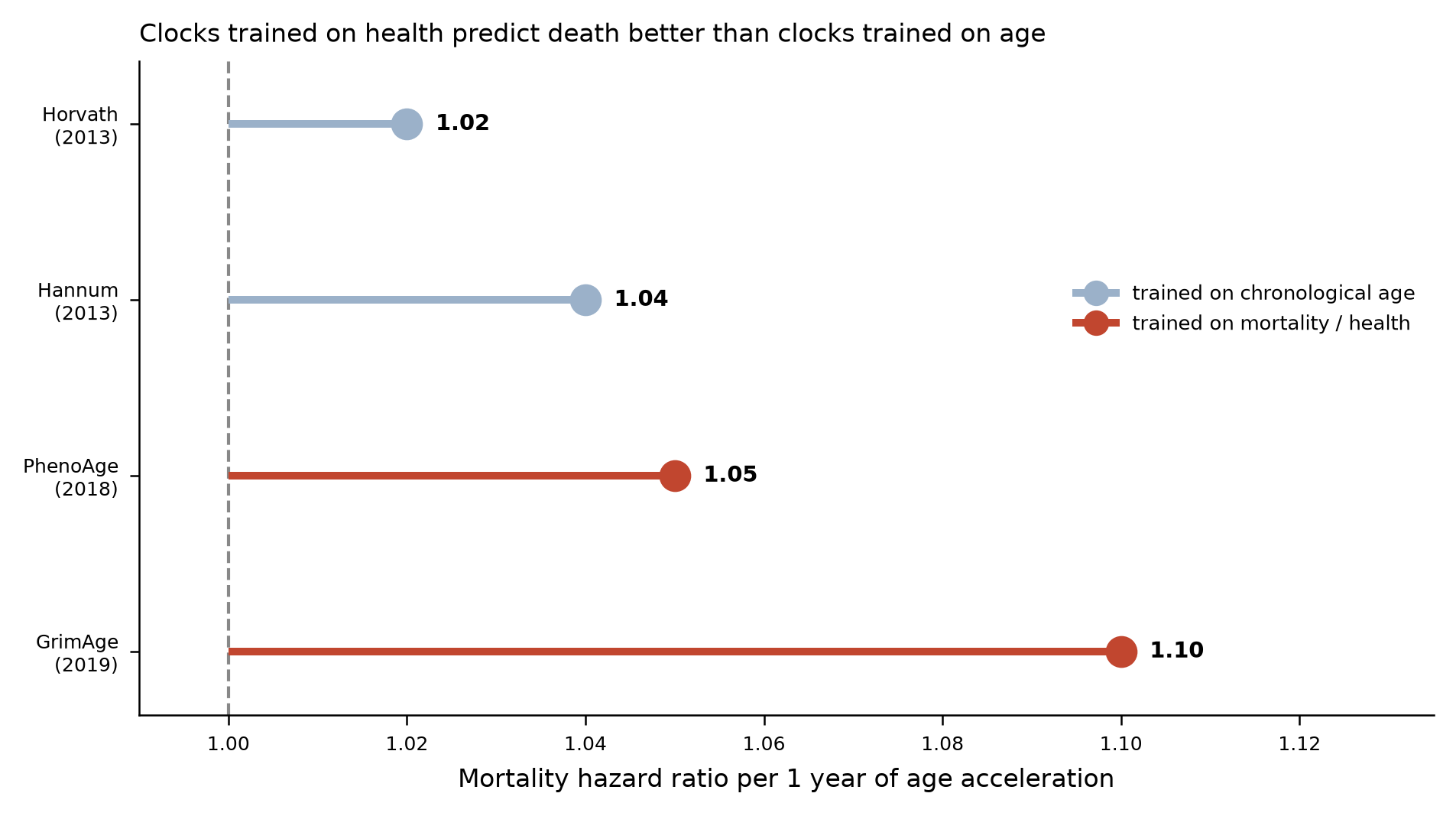
Start with the strongest evidence that these clocks work, because it is genuinely strong. In 2015, Marioni and colleagues followed four groups of older adults, the two Lothian Birth Cohorts, Framingham, and the Normative Aging Study, and asked whether the clock’s deviation predicted death.⁴ It did. Pooled across the cohorts, someone whose clock ran five years ahead of their age had a 21 percent higher risk of dying, adjusting for age and sex, and still a 16 percent higher risk after also accounting for education and social class, common conditions like high blood pressure and diabetes, and the main genetic risk factor for Alzheimer’s.⁴ Later clocks trained on health data, rather than age alone, did better still: GrimAge carried roughly a 10 percent higher mortality risk for each year it read above your age.¹ This part is not in dispute: taken once, the number forecasts real outcomes. But forecasting is not the same as measuring, and four findings show where the two part ways.
First, “biological age” is not one thing, and the measures built to capture it do not agree. In 2018, Belsky and colleagues tested this directly in 964 middle-aged adults from New Zealand’s Dunedin study, applying eleven different measures of biological aging, including telomere length, three epigenetic clocks, and composite scores from routine blood markers, to the same people.⁵ If they were all reading one process, they should have lined up. They did not. The paper found low agreement between the measures and concluded they “may not measure the same aspects of the aging process.”⁵ A 2019 Genome Biology review by Bell and more than twenty co-authors put it plainly: “‘Biological age’ is a large umbrella term for multiple age-related phenotypes and disease processes.”⁶ Inflammation, metabolism, cellular wear, and organ decline do not age in lockstep, and a single number cannot represent them; it averages genuinely different things into one figure.
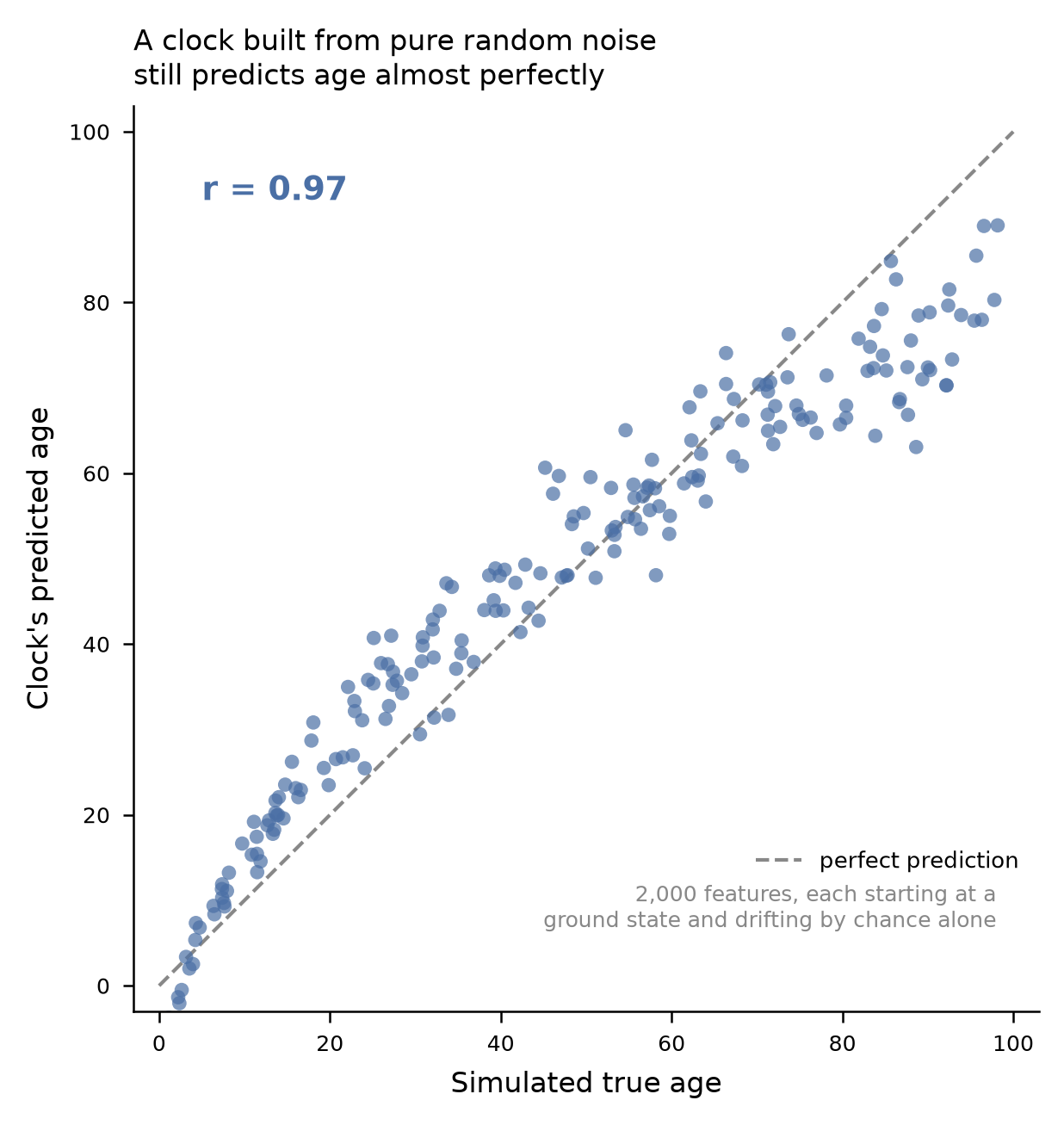
Second, and sharpest, a 2024 simulation. Meyer and Schumacher, in Nature Aging, asked how much biology you need to build a working clock.⁷ Close to none. They generated 2,000 random data points and let them drift by pure chance from a shared “ground state” standing in for age zero, with no program and no coordinated signal, just accumulating randomness. A clock trained on that noise predicted the simulated age almost perfectly, and it reproduced the effects real clocks are known for detecting, correctly reading calorie restriction, smoking, and cellular reprogramming as speeding aging up or slowing it down.⁷ The authors are careful, and I will not overstate it: they note the result cannot rule out a genuine programmed process underneath. But it is a humbling result. A clock nailing your age is no proof it has found a signal your body is deliberately maintaining. Random accumulation is enough.
Third, cause, the part that matters most for anyone hoping to change their number. Also in 2024, Ying and colleagues, in Nature Aging, used a genetic method called Mendelian randomization, which uses randomly inherited DNA variants to separate cause from coincidence, across 420,509 methylation sites and eight aging traits, to tell apart sites that cause aging from ones that merely track it.⁸ They then checked seven leading clocks, including Horvath, Hannum, PhenoAge, GrimAge, and DunedinPACE, for whether they were built from causal sites. None were.⁸ The clocks are assembled, by design, from marks that correlate tightly with age, and those turn out mostly not to be the marks that drive it. The authors’ response was a pair of new “causality-aware” clocks, DamAge and AdaptAge, which itself suggests the current clocks are not built on the sites you would want to target to change your aging.
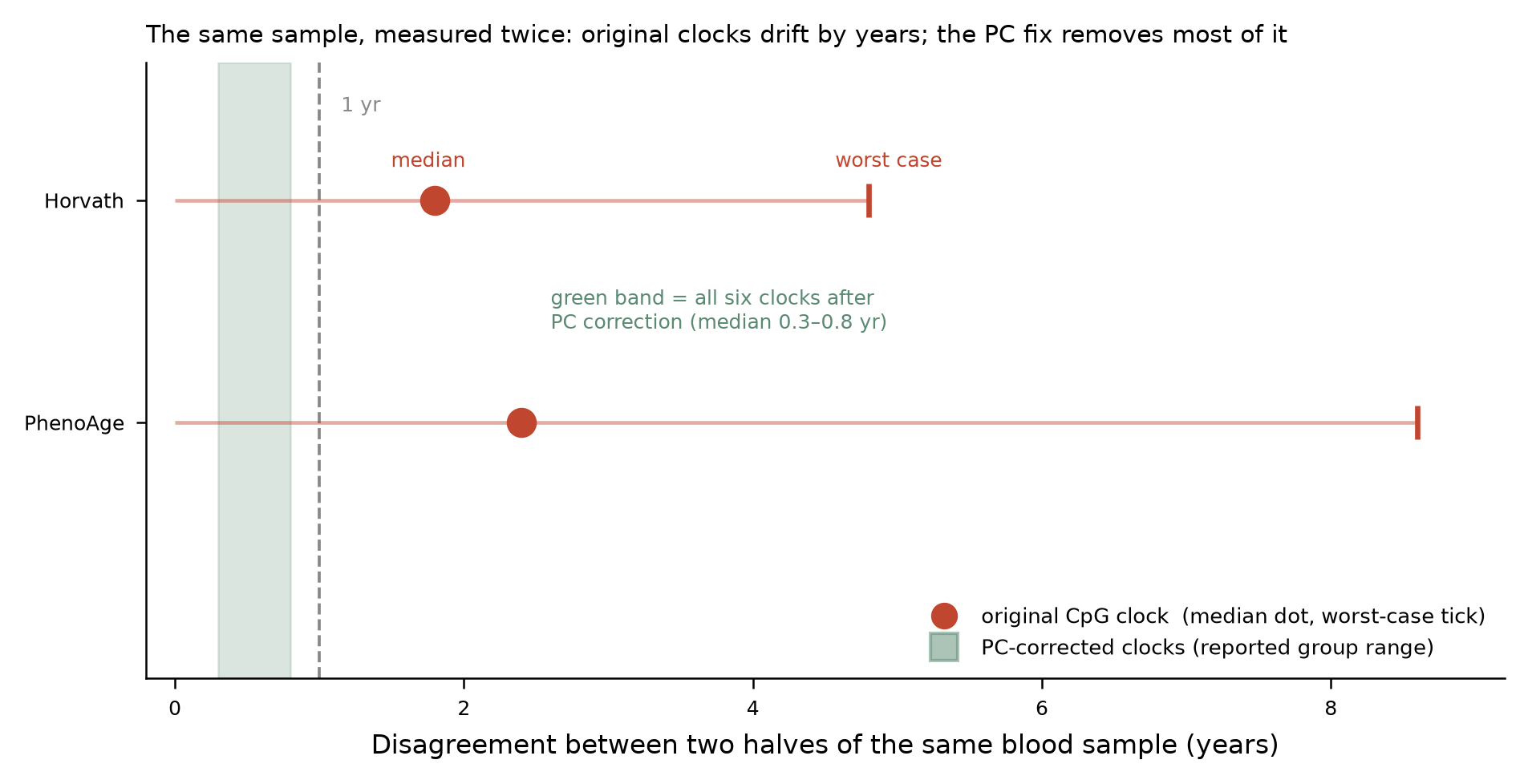
Fourth, and why “watching your number” is so fragile: the deviation is also where the measurement noise piles up. When one group split single blood samples in two and ran the same clock on both halves, the original Horvath clock’s two answers differed by a median of 1.8 years and up to 4.8; PhenoAge drifted a median of 2.4 years, with a maximum gap of 8.6 years between two tubes of identical blood.⁹ The reason is the raw material: across more than 400,000 methylation sites measured twice on the same DNA, the average site’s reproducibility was 0.21, on a scale where anything under 0.4 is “poor.”¹⁰ The clocks work by averaging hundreds of shaky signals so the wobble partly cancels. Partly. Enough survives that a two-year “improvement” between visits can be the test landing somewhere else rather than your biology changing. This limitation was not fully characterized until 2022, years into the tests being available.
A prediction is not a measurement
Put those together and the number comes into focus. It is a prediction, not a measurement, and the clocks are good at predicting precisely because of what makes them poor at measuring.
Consider a thermometer versus a credit score. A thermometer measures temperature: change the number and you have changed the state, because the number is the temperature. A credit score is the opposite. It predicts whether you will default, accurately, without measuring your character, by piling up correlated proxies: payment history, balances, how long your accounts have been open. Aging clocks behave like the credit score, not the thermometer. They pile up molecular correlates of time and accumulated damage into a number that forecasts well precisely because it captures the wear a life has already put on you, not a dial you can turn.
That is why a better forecast is not automatically better news. A clock that predicts death more accurately is most likely reading accumulated damage and a lifetime of exposures more accurately, and those are among the hardest things to reverse. The better the forecast, the less certain it is that moving the number moves your fate. A good prediction of where a road ends is not a map of the road, and nowhere near a steering wheel
What the number is good for, and what it isn’t
Start with what these tests genuinely do. They read your chronological age with uncanny accuracy, and the best predict your risk of disease and death better than your birthday alone, from a single blood draw.¹ ⁴ Taken once, a biological-age reading is a legitimate risk flag, in the same family as a cholesterol number: a snapshot that compares you against a large group and can reasonably start a conversation with your doctor. The field is moving quickly, and the underlying science is genuine.
What the evidence does not yet support is the way the number is often used: watched over time, and driven down. Tracking the number month to month assumes the deviation is stable enough to follow in one person, but that deviation is exactly where the measurement noise piles up and where the causal signal is thinnest.⁸ ⁹ Lowering it assumes moving the figure moves your outcome, and that needs two things nobody has delivered together yet: a clock proven to sit on causal biology, and a long trial showing that when the number falls, real disease and death fall with it. Until both exist, driving your number down is a bet that the correlation reflects cause. That bet may pay off. Today it is unproven.
Treat the reading as a forecast, not a fact. Take the snapshot and let it inform your sense of risk the way any predictor should. But keep the distinction in mind: what the number gives you today is a prediction, not a measurement, and the day it becomes a measurement you can act on will be marked by a decade-long trial, not a smaller number on your next retest.
References
1. Lu AT, Quach A, Wilson JG, et al. DNA methylation GrimAge strongly predicts lifespan and healthspan. Aging (Albany NY). 2019;11(2):303-327. doi:10.18632/aging.101684
2. Horvath S. DNA methylation age of human tissues and cell types. Genome Biol. 2013;14(10):R115. doi:10.1186/gb-2013-14-10-r115
3. Hannum G, Guinney J, Zhao L, et al. Genome-wide methylation profiles reveal quantitative views of human aging rates. Mol Cell. 2013;49(2):359-367. doi:10.1016/j.molcel.2012.10.016
4. Marioni RE, Shah S, McRae AF, et al. DNA methylation age of blood predicts all-cause mortality in later life. Genome Biol. 2015;16(1):25. doi:10.1186/s13059-015-0584-6
5. Belsky DW, Moffitt TE, Cohen AA, et al. Eleven telomere, epigenetic clock, and biomarker-composite quantifications of biological aging: do they measure the same thing? Am J Epidemiol. 2018;187(6):1220-1230. doi:10.1093/aje/kwx346
6. Bell CG, Lowe R, Adams PD, et al. DNA methylation aging clocks: challenges and recommendations. Genome Biol. 2019;20(1):249. doi:10.1186/s13059-019-1824-y
7. Meyer DH, Schumacher B. Aging clocks based on accumulating stochastic variation. Nat Aging. 2024;4(6):871-885. doi:10.1038/s43587-024-00619-x
8. Ying K, Liu H, Tarkhov AE, et al. Causality-enriched epigenetic age uncouples damage and adaptation. Nat Aging. 2024;4(2):231-246. doi:10.1038/s43587-023-00557-0
9. Higgins-Chen AT, Thrush KL, Wang Y, et al. A computational solution for bolstering reliability of epigenetic clocks. Nat Aging. 2022;2(7):644-661. doi:10.1038/s43587-022-00248-2
10. Sugden K, Hannon EJ, Arseneault L, et al. Patterns of reliability: assessing the reproducibility and integrity of DNA methylation measurement. Patterns (N Y). 2020;1(2):100014. doi:10.1016/j.patter.2020.100014