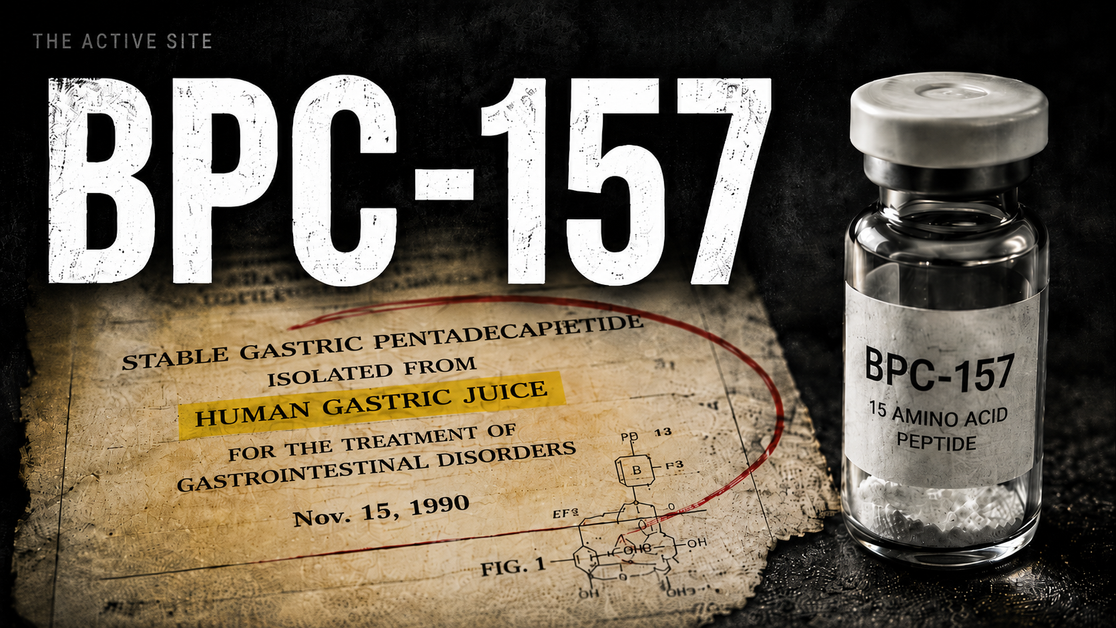
BPC-157 is now used as a recovery peptide for tendon injuries, muscle strains, and stubborn joint problems. Some people report remarkable results, while others feel nothing. But its story did not begin in sports medicine. It traces back through human stomach fluid, an old Yugoslav research program, pharmaceutical development, and decades of experiments that still leave major parts of the peptide’s history unresolved. This investigation follows that evidence from the beginning to find out what BPC-157 actually is, what it may be doing, and how it became the healing peptide.
Time stamps:
0:00 – What BPC-157 really is
2:02 – How it got its name
4:50 – What the animal studies show
8:33 – The science that still doesn't add up
10:28 – A stability problem nobody talks about
12:17 – The human trial history
13:43 – A missing piece in the story
15:17 – What the evidence still doesn't prove
16:29 – Where things stand now
IN THIS INVESTIGATION
- How an idea that began in Yugoslavia in the 1970s eventually produced the fifteen-amino-acid peptide now known as BPC-157.
- What the original patents actually say about material collected from human gastric juice, and why parts of that origin story remain unusually difficult to reconstruct.
- What happened when independent laboratories tested BPC-157 in tendon cells, blood vessels, bone repair, and human artery tissue.
- Why the phrase “stable gastric pentadecapeptide” appears throughout the literature, and what happened when the peptide’s stability was tested directly.
- How BPC-157 moved from a pharmaceutical program for gastrointestinal disease into the modern world of injected injury recovery.
- What the first randomized trial designed around the modern musculoskeletal use of BPC-157 is now attempting to answer.
REFERENCES
Sikirić P, et al. The significance of the gastroprotective effect of body protection compound (BPC): modulation by different procedures. Acta Physiol Hung. 1992;80(1-4):89-98. PMID 1345210.
Sikirić P, et al. Hepatoprotective effect of BPC 157, a 15-amino acid peptide. Life Sci. 1993;53(18):PL291-296. PMID 7901724. DOI 10.1016/0024-3205(93)90589-U.
Sikirić P, et al. A new gastric juice peptide, BPC. J Physiol Paris. 1993;87(5):313-327. PMID 8298609. DOI 10.1016/0928-4257(93)90038-U.
Šebecić B, et al. Osteogenic effect of a gastric pentadecapeptide, BPC-157, on the healing of segmental bone defect in rabbits. Bone. 1999;24(3):195-202. PMID 10071911. DOI 10.1016/S8756-3282(98)00180-X.
Chang CH, et al. The promoting effect of pentadecapeptide BPC 157 on tendon healing involves tendon outgrowth, cell survival, and cell migration. J Appl Physiol. 2011;110(3):774-780. PMID 21030672. DOI 10.1152/japplphysiol.00945.2010.
Hsieh MJ, et al. Therapeutic potential of pro-angiogenic BPC157 is associated with VEGFR2 activation and up-regulation. J Mol Med. 2017;95(3):323-333. PMID 27847966. DOI 10.1007/s00109-016-1488-y.
Yildirim AK, et al. Endothelium-Dependent Nitric Oxide-Mediated Vasorelaxant Effects of BPC 157 in Human Internal Mammary Artery. J Clin Med. 2026;15(9):3488. PMID 42123221. DOI 10.3390/jcm15093488.
Xu C, et al. Preclinical safety evaluation of body protective compound-157, a potential drug for treating various wounds. Regul Toxicol Pharmacol. 2020;114:104665. PMID 32334036. DOI 10.1016/j.yrtph.2020.104665.
He L, et al. Pharmacokinetics, distribution, metabolism, and excretion of body-protective compound 157 in rats and dogs. Front Pharmacol. 2022;13:1026182. PMID 36588717. DOI 10.3389/fphar.2022.1026182.
Józwiak M, et al. Multifunctionality and Possible Medical Application of the BPC 157 Peptide: Literature and Patent Review. Pharmaceuticals. 2025;18(2):185. PMID 40005999. DOI 10.3390/ph18020185.
Vasireddi N, et al. Emerging Use of BPC-157 in Orthopaedic Sports Medicine: A Systematic Review. HSS J. 2025;21(4):485-495. PMID 40756949. DOI 10.1177/15563316251355551.
McGuire FP, et al. Regeneration or Risk? A Narrative Review of BPC-157 for Musculoskeletal Healing. Curr Rev Musculoskelet Med. 2025;18(12):611-619. PMID 40789979. DOI 10.1007/s12178-025-09990-7.
FDA. BPC-157-Related Bulk Drug Substances: Pharmacy Compounding Advisory Committee Briefing Document. May 11, 2026. PCAC meeting July 23-24, 2026.
US Patent 5,288,708. Body Protection Compound isolated from gastric juice.
US Patent 9,850,282 B2 / WO 2014/142764 A1. Stable pentadecapeptide salts.
http://ClinicalTrials.gov . NCT07437547. Phase 2 randomized, double-blind, placebo-controlled study of subcutaneous BPC-157 in MRI-confirmed grade II hamstring strain.
Talpos S. Investigation into the origin and development of BPC-157. Undark, May 29, 2026; co-published with STAT.
NOTE: This video is educational content. It is not medical advice