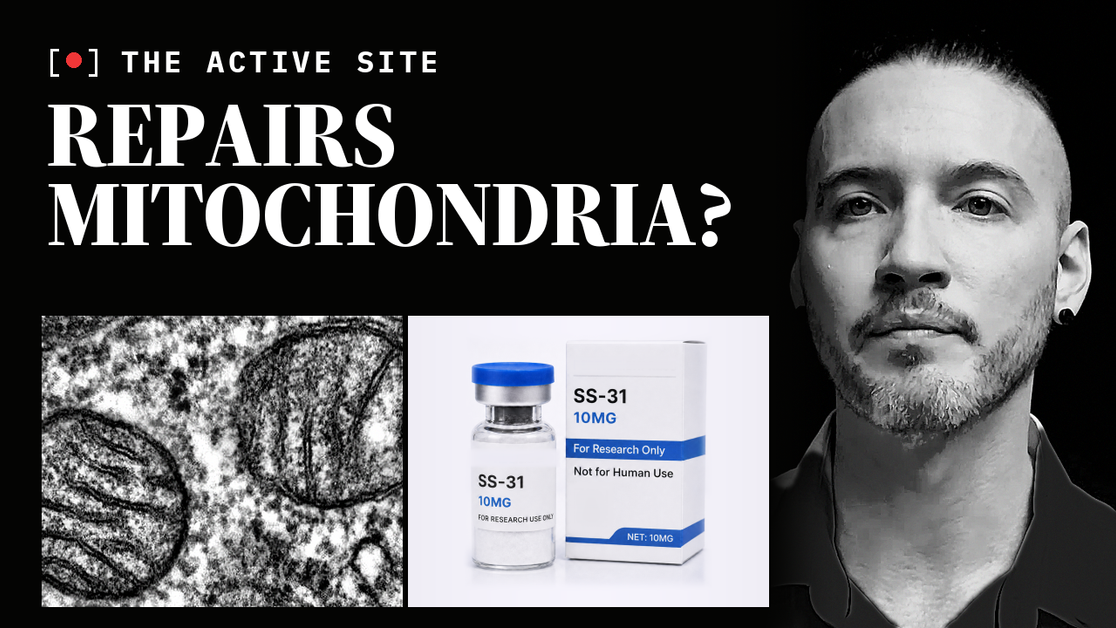
SS-31 is sold online by the vial as a peptide that repairs your mitochondria, with the promise of more energy and slower aging. In September 2025 the FDA gave it accelerated approval as elamipretide, under the brand name Forzinity, but only to improve muscle strength in one rare inherited disease, and over the objections of its own clinical reviewers. The story of SS-31 begins with a painkiller that ended up somewhere it was not supposed to go. This investigation follows that evidence from a Montreal lab to old mice and two small trials in people, to determine what SS-31 has been shown to do, and whether its promise to repair your mitochondria has been earned.
What this episode tested
Each claim the episode covers, and where the cited studies land. Numbers refer to the references below.
- SS-31 repairs mitochondria in people.Not supported
Repair has not been shown in people. The only published trial of the aging claim measured how much energy a small hand muscle could make after a single dose, not whether its mitochondria had changed. The only sign of anything like repair in the record comes from mice bred with the Barth defect, whose mitochondria kept more of their accordion-like folds on the drug.
- SS-31 reaches the inner mitochondrial membrane and binds cardiolipin.Supported
In laboratory experiments, the peptide collects on the inner membrane, where cardiolipin sits, and binds that fat. The FDA's pharmacologists accepted this targeting. What that binding does for a person's stamina is a separate question the chemistry cannot answer.
Refs 4 - A single dose makes old mouse muscle produce energy as well as the muscle of young mice.Animal only
In 2013, an hour after one dose, old mice's leg muscle was making energy as well as the muscle of young mice and took longer to tire. The same dose did nothing measurable in young mice. An hour is too short to repair or replace damaged mitochondria. These are results in mice, not in people.
Refs 5 - A single infusion gives older adults a lasting gain in energy or stamina, comparable to six months of exercise.Not supported
In the MOTION trial, 39 healthy adults aged 60 to 85 received a two-hour infusion. A laboratory reading of how fast a small hand muscle could make ATP rose 27 percent on the drug and 12 percent on placebo, a gap that counts as statistically significant or not depending on how it is calculated. The muscle did not keep working longer than on placebo, and a week later even the reading no longer differed. Nobody in the trial trained. It is still the only published trial of the aging claim in people.
Refs 8 - Elamipretide improved walking distance and fatigue in people with Barth syndrome during the blinded TAZPOWER trial.Not supported
Twelve patients each took the drug for 12 weeks and a placebo for 12 weeks, in an order hidden from patients and staff. When that order was revealed, the patients had walked about 30 meters farther in six minutes on placebo than at the start, and exactly as far on the drug. Fatigue and knee strength did not differ. The trial missed both of its goals.
Refs 9 - Elamipretide improved walking distance and fatigue in adults with other genetic mitochondrial diseases that weaken muscle.Not supported
In MMPOWER-3, 218 adults took the drug or placebo for 24 weeks. The drug did no better than placebo on walking distance or fatigue.
Refs 10 - The open-label extension shows that elamipretide improves strength and walking in Barth syndrome.Mixed
After everyone moved onto the drug and knew they were taking it, typical knee strength at 12 weeks had risen by about a quarter of typical starting strength. Three years on, the patients who stayed were stronger still and walking about 96 meters farther in six minutes than before the trial began. Fatigue scores had not clearly improved. Patients who had been on the drug twice as long had gained about the same. Without a comparison group, and with a test that depends on how hard a person pushes, there was no way to tell what caused the gains. The FDA told the company those extension data are not interpretable in the absence of a control arm.
- The FDA approval means SS-31 improves energy, stamina, or aging in otherwise healthy people, or that vials sold online are the approved drug.Not supported
The September 19, 2025 decision is an accelerated approval of elamipretide, under the brand name Forzinity, to improve muscle strength in Barth syndrome, in patients who weigh at least 30 kilograms. The FDA wrote that it could not conclude the strength gain is in itself a benefit to patients, or that walking or fatigue had improved, and it required a new blinded, placebo-controlled trial due to report in 2030. All 12 patients in the trial had reactions where the drug was injected, and serious allergic reactions are a recognized risk. The approval covers one prescription product for one rare disease. It does not establish those wider benefits, and it says nothing about the quality of vials sold online by unrelated vendors. In August 2026 the FDA warned online peptide sellers that the SS-31 they sell is an unapproved new drug.
Timestamps
Transcript
Lightly cleaned from the episode's transcript. Click a time to jump to that point in the video.
Show full transcript
SS-31 is now sold online by the vial as a peptide that repairs mitochondria, the structures that supply much of the energy our cells use. The promise is more energy and slower aging. Interest rose after September 2025 when the FDA approved it as a drug called elamipretide and more than 50 podcast episodes have carried its name in their title since.
That approval covers muscle strength in one rare inherited disease, and it was granted over the objections of the FDA's own clinical reviewers. Less than a year later, the FDA warned online peptide sellers that the SS-31 they sell is an unapproved new drug, research-use-only label or not. So how did a drug for one rare disease become a peptide sold to repair your mitochondria?
I am William Wallace and this is The Active Site.
The story of SS-31 begins with a painkiller that ended up somewhere it was not supposed to go. In 1989, in the Journal of Medicinal Chemistry Peter Schiller's laboratory at the Clinical Research Institute of Montreal described a small opioid peptide. It carried so much electrical charge that its designers wrote it "most likely will not be able to cross the blood-brain barrier."
Hazel Szeto's team at Weill Cornell worked with Schiller on a close relative of that peptide. In rodents, it relieved pain through the brain and spinal cord anyway. The team later wrote in Clinical Pharmacology and Therapeutics in 2014 that they had "accidentally discovered" that effect. When they attached a fluorescent tag to see where the peptide was going, it collected in the mitochondria.
They redesigned it to keep that targeting and lose the opioid effect, and the result was SS-31, named for Szeto and Schiller. Cornell and the Montreal Institute filed to patent it in 2003, and in 2004 in the Journal of Biological Chemistry, the team reported that these peptides reached the inner membrane of mitochondria.
In 2006, a company now called Stealth BioTherapeutics was set up to develop it with Szeto as a founder and the drug was later named elamipretide.
In a talk in 2021, she summed up what it does.
SS-31 was shown to specifically target to the inner mitochondria membrane, bind to cardiolipin and prevent the peroxidation of cardiolipin.
That sentence makes two claims and the first is about where the peptide goes. Inside each mitochondrion energy is made on an inner membrane, a thin sheet folded back and forth like an accordion so it can hold more of the machinery that makes ATP. The molecule cells spend as energy. Those folds depend on cardiolipin, a fat found almost nowhere else in the cell.
Most membrane fats have two fatty tails, but cardiolipin has four, which gives it a wedge shape that helps the sheet bend into tight folds and it holds the energy-making proteins together in working groups. SS-31 is a chain of four amino acids and two of the four carry a positive charge. Cardiolipin carries a negative charge and because opposite charges attract, the peptide is drawn to it.
What makes SS-31 unusual is that most drugs fit into a protein while this one slips into cells, collects on the one membrane where cardiolipin sits and binds to the fat itself. That much has been shown in the laboratory and the FDA's pharmacologists accepted it. The second claim is about peroxidation, the damage reactive forms of oxygen do to fats, the same chemistry that turns cooking oil rancid.
When that damage hits cardiolipin, the folds flatten, the machinery comes apart, and the cells make less energy. The proposal is that SS-31 sitting on cardiolipin shields it, so the machinery the cell already has works better. Even if that is right, stamina depends on muscle, and the chemistry cannot say whether reaching cardiolipin lets muscle do more, or whether a person would feel it.
The case that it could make aging muscle do more started in old mice. In 2013, in the journal Aging Cell, a team at the University of Washington in Seattle with Szeto among the authors gave old mice a single dose. An hour later, their leg muscle was making energy as well as the muscle of young mice and took longer to tire, while the same dose did nothing measurable in young mice.
The authors pointed out that an hour is too short to repair or replace damaged mitochondria. In their reading, the old mitochondria were working better without being rebuilt. In 2016, in the journal Scientific Reports, an independent laboratory at the University of Liverpool found that 15 weeks of treatment left less chemical damage in old muscle but no gain in size or strength.
In 2019, the Seattle team reported that after eight weeks, old mice ran nearly twice as long on a treadmill. A mouse cannot say whether it feels any different, and by the time those longer studies come out, the promise had already been tested in people. In 2015 and 2016, the Seattle team ran a trial called MOTION, which the company funded and helped design, giving older adults a single dose.
Before the results were published, the company's chief executive officer described them in a 2020 talk on treating diseases of aging.
Two hours after a single infusion of elamipretide, we saw about a 30% increase in mitochondrial respiration in the thenar muscle group. And that was associated with an improvement in function. And it's roughly comparable to what was seen in a very similar patient population after about six months of endurance exercise training.
The paper published in PLOS One in 2021 made a similar comparison. The trial enrolled 39 healthy adults between 60 and 85, chosen because they scored low on one laboratory reading. The reading was how fast the mitochondria in a small hand muscle between the thumb and index finger could make ATP while it worked inside a scanner.
After a two-hour infusion, that reading rose 27% on the drug and 12% on placebo, a gap that counts as statistically significant or not, depending on how it's calculated. On how long the muscle could keep working, the drug did no better than placebo. And a week later, even the reading no longer differed. Nobody in this trial trained at all since the six months of exercise came from other studies.
One dose may have briefly nudged a laboratory reading in a muscle that started low. The trial did not show that anyone felt more energetic or could do more. And it's still the only published trial of the aging claim in people.
The approval its promoters point to came out of a separate program built around a rare disease in which the body cannot properly finish making cardiolipin. That disease is Barth syndrome, an inherited condition mostly of boys and men. A faulty gene leaves their cells with too little finished cardiolipin.
The very fat SS-31 binds and the result is a weakened heart, weak muscles, and fatigue with the risk of death highest in the first years of life. About 150 people in the United States have it and there was no approved treatment.
Stealth BioTherapeutics filed patents on using the drug for Barth syndrome in 2013 as drug companies routinely do and in 2017 it began a trial called TAZPOWER in 12 patients led by Hilary Vernon at Johns Hopkins. Each patient took the drug for 12 weeks and a placebo for 12 weeks and an order hidden from patients and staff. Seven years later, at a public FDA hearing, one of the 12 people described it.
I was randomized in the double-blind study of elamipretide, not knowing whether I was on placebo or drug. Gradually, after receiving the study drug, I began having more energy. I was able to come home from work and not go straight to bed. I still do not know to this day if I was on active drug, but my guess is I was. I eventually had to go through the washout portion of the trial where I gradually was completely back to my old self, tired, weak muscles, drained of energy, and very frustrated.
Coming home from work with energy to spare is exactly what people hoped for from this drug and nothing in the trial suggests that experience was not real. What the trial could add was whether that drug caused it. When the hidden order was revealed, the patients had walked about 30 meters farther in six minutes on placebo than at the start and exactly as far on the drug.
Fatigue and knee strength did not differ either. The investigators reported this in the journal Genetics in Medicine in 2021. 12 patients over 12 weeks is a small test that can miss a real effect, but TAZPOWER missed both of its goals, walking and fatigue. It is also the trial that would get the drug approved.
A much larger trial called MMPOWER-3 was running at the same time in 218 adults with other genetic mitochondrial diseases that weaken muscle. After 24 weeks, the drug did no better than placebo on walking distance or fatigue. The investigators reported that in Neurology in 2023. In the Barth trial, meanwhile, knee strength had barely changed, while the patients did not know whether they were getting the drug.
Once they moved into an extension where everyone got the drug and everyone knew it, the typical gain after 12 weeks was about a quarter of the typical starting strength. Three years on, the patients who stayed were stronger still and walking about 96 meters farther in six minutes than before the trial began.
This was reported in Genetics in Medicine in 2024, though their fatigue scores still had not clearly improved. The same patients had taken the same drug and done the same test and gotten two very different results, so something else had changed. More time on the drug was one possibility, but the FDA's reviewers checked, and patients who had been taking it twice as long had gained about the same.
What had changed for certain was that everyone now knew they were on it, during a test that depends on how hard a person pushes and some of the patients were also still growing. That does not prove expectation produced the gains. It means that without a comparison group, there was no way to tell and those numbers became the core of Stealth BioTherapeutics' case for approval.
The only way to settle that was a controlled trial and the FDA said so. In 2019 it told Stealth BioTherapeutics that data from the open extension are not interpretable in the absence of a control arm and in 2020 it said a controlled trial was feasible and ethical. Stealth and patient advocates answered that another long controlled trial in a disease this rare and serious was neither achievable nor ethical.
In 2021, it applied for approval anyway without that trial, and after the FDA refused to even review the application, it applied again in 2024. In October 2024, the FDA put the question to a panel of outside advisors, and at the public hearing, a parent described seeing a son walk ahead for the first time. Then the panel voted on whether the drug is effective for Barth syndrome.
I will now read the vote into the record. Ten yeses, six noes.
Some who voted yes said the evidence, imperfect as it all was, added up for a disease this rare. One of the six who voted no, the biostatistician Susan Ellenberg of the University of Pennsylvania, said she was torn, and she explained why.
I felt like the most compelling thing that we heard was from the people who spoke in the open public hearing, and it's hard to know what to do with that. I've been involved with clinical research for a very long time, and I've seen many examples where people were given a treatment, mostly in surgical kinds of things, where they felt enormously better and swore up and down that, you know, their life was changed, and when a randomized trial was done, there was no effect.
Her examples came from other treatments, so they say nothing about whether these patients improved, but they show why even a strong sense of improvement cannot, by itself, show what caused it. The panel's yes was only advice, though, and the decision still belonged to the FDA. Seven months after its advisors voted 10 to 6 that the drug was effective, the FDA rejected it.
In the same letter, it suggested a narrower route called accelerated approval, which rests on a measure reasonably likely to predict a real benefit, here, knee strength, and requires a later trial to confirm it. Two months later, Hilary Vernon, who led the Barth trial, and whose research the company has funded, put the clinical review plainly.
So the positive things that I can say is that I've seen the difference this has made in my patients. I believe that this is an effective agent that has offered benefit for people.
The FDA's own clinical reviewers recommended against that route too. In September 2025, the director of their office approved the drug anyway. What persuaded the director was the size and persistence of the strength gain. It was several times any change seen on placebo. It was still there after three years.
And in the blinded trial, when the same patients knew they might be on the drug, expectation alone had not made them stronger. The FDA's record says the two sides agreed on the findings and differed on how much uncertainty to accept. And with about 150 patients and no approved treatment, the director accepted more. The approval covers muscle strength in Barth patients who weigh at least 30 kilograms.
The FDA wrote that it could not conclude the gain is in itself a benefit to patients or that walking or fatigue had improved and it required a new blinded placebo-controlled trial due to report in 2030. All 12 patients in the trial had reactions where the drug was injected and serious allergic reactions are a recognized risk.
That decision concerned patients with a rare inherited disease and very few options and someone buying SS-31 to hold on to their energy as they age is asking for something very different. Within months though, some of the pages promoting it were presenting the approval as support for everything else.
Three months after the approval, Martin Picard, who studies mitochondria at Columbia University, was asked in a podcast interview about the peptides people were injecting, SS-31 among them.
So it's not lived up to its expectation. It was supposed to be a treatment for mitochondrial disease, and mostly the trials have been negative.
Online, the claims went much further and in a video posted in August 2026, one creator moved from Barth syndrome to everything else in a single sentence.
Once I read about how it works for people with Barth syndrome, which is what it's FDA approved for, which is mitochondrial dysfunction, my immediate thought was, well, the average person could certainly use this who doesn't have mitochondrial dysfunction and drastically restore their mitochondria to an optimal state. There's no reason that it couldn't do that.
No trial has tested that leap and the closest evidence is a reason for caution. In the 2013 Seattle study, the dose that brought old mouse muscle up to the level of young muscle did nothing measurable in young mice. The Seattle team behind the older adult trial took that to mean the drug does little for mitochondria that already work well.
Repair has not been shown in people either because the older adult trial measured how much energy muscle could make, not whether its mitochondria had changed. The only sign of anything like repair in the record comes from mice bred with Barth defect, whose mitochondria on the drug kept more of the accordion-like folds where the energy-making machinery sits.
For an otherwise healthy person, considering SS-31 for energy, endurance or aging, the biology justifies continued research. In the laboratory, the peptide reaches its target, and in old mice, it changes how muscle makes energy. The human evidence does not justify expecting dependable gains in energy or stamina.
As the FDA summed up the program, some small trials reported benefits that larger controlled trials did not confirm. The approval covers one prescription product for one rare disease and it says nothing about the quality of vials sold online by unrelated vendors.
What would change that judgment is a controlled trial in which older adults who take the drug for months end up stronger, less easily tired or able to do more than those on placebo. A small safety study of daily doses in older adults began in Seattle in late 2025 with no placebo group and a placebo controlled trial is still only a plan.
Holding on to energy and stamina as we age is a powerful promise and repairing your mitochondria is how it's sold. On the evidence so far, SS-31 has not been shown to do either. That is all for this episode. Thank you to everyone who made it to the end. If you found this useful, please like, subscribe, and comment. Until next time, stay healthy.
References
- Schiller PW, et al. Dermorphin analogues carrying an increased positive net charge in their "message" domain display extremely high mu opioid receptor selectivity. J Med Chem. 1989. PMID 2537427. PMID 2537427
- Szeto HH, Birk AV. Serendipity and the discovery of novel compounds that restore mitochondrial plasticity. Clin Pharmacol Ther. 2014. PMID 25188726. PMID 25188726
- Szeto HH, Zhao K, Schiller PW. US Patent 7,576,061 B2. Filed 2003. US 7,576,061 B2
- Zhao K, et al. Cell-permeable peptide antioxidants targeted to inner mitochondrial membrane inhibit mitochondrial swelling, oxidative cell death, and reperfusion injury. J Biol Chem. 2004. PMID 15178689. PMID 15178689
- Siegel MP, et al. Mitochondrial-targeted peptide rapidly improves mitochondrial energetics and skeletal muscle performance in aged mice. Aging Cell. 2013. PMID 23692570. PMID 23692570
- Sakellariou GK, et al. Mitochondrial ROS regulate oxidative damage and mitophagy but not age-related muscle fiber atrophy. Sci Rep. 2016. PMID 27681159. PMID 27681159
- Campbell MD, et al. Improving mitochondrial function with SS-31 reverses age-related redox stress and improves exercise tolerance in aged mice. Free Radic Biol Med. 2019. PMID 30597195. PMID 30597195
- Roshanravan B, et al. In vivo mitochondrial ATP production is improved in older adult skeletal muscle after a single dose of elamipretide in a randomized trial. PLoS One. 2021. PMID 34264994. (MOTION trial) PMID 34264994
- Thompson WR, et al. A phase 2/3 randomized clinical trial followed by an open-label extension to evaluate the effectiveness of elamipretide in Barth syndrome, a genetic disorder of mitochondrial cardiolipin metabolism. Genet Med. 2021. PMID 33077895. (TAZPOWER trial) PMID 33077895
- Karaa A, et al. Efficacy and safety of elamipretide in individuals with primary mitochondrial myopathy: the MMPOWER-3 randomized clinical trial. Neurology. 2023. PMID 37268435. PMID 37268435
- Thompson WR, et al. Long-term efficacy and safety of elamipretide in patients with Barth syndrome: 168-week open-label extension results of TAZPOWER. Genet Med. 2024. PMID 38602181. PMID 38602181
- US FDA. Cardiovascular and Renal Drugs Advisory Committee on elamipretide, minutes and transcript. October 10, 2024. FDA meeting page
- US FDA. Complete response letter, NDA 215244. May 15, 2025. FDA complete response letter
- US FDA. Integrated review, approval letter and Forzinity prescribing information, NDA 215244. September 19, 2025. FDA approval package
- Stealth BioTherapeutics. Clinical Trial in Patients With Barth Syndrome (4TAZPower). ClinicalTrials.gov NCT07531251. NCT07531251
- US FDA. Warning letters to online peptide sellers. August 24, 2026. FDA warning letter
- Russo S, et al. SS-31 treatment ameliorates cardiac mitochondrial morphology and defective mitophagy in a murine model of Barth syndrome. Sci Rep. 2024. PMID 38871974. PMID 38871974
- Marcinek D, University of Washington. Study of Healthy Aging and Physical Function With Elamipretide (SHAPE). ClinicalTrials.gov NCT07275424. NCT07275424
Building photographs, cropped, via Wikimedia Commons: Clinical Research Institute of Montreal by Jeangagnon (CC BY-SA 3.0); Weill Cornell Medicine by Kenneth C. Zirkel (CC BY-SA 4.0).

