NOVEMBER 27, 2026
This Week in Health Science
The newest research in medicine, health tech, nutrition and supplements, and what it means for you.
The biggest result of the week came from a heart trial of more than 16,000 people. Inclisiran, a cholesterol shot given just twice a year, reduced heart attacks, strokes and related events, which is the test every cholesterol drug has to pass beyond lowering a lab number. The size of the benefit hasn't been released yet, and that matters, but it is the first proof that this new kind of drug reduces the events people actually fear.
The rest of the week is just as practical. People on tirzepatide who lifted weights kept more of their muscle, BMI alone missed obesity in a meaningful share of adults, and a viral plastics paper turned out to show less than its headlines. Closer to home, two official measles death counts don't agree, and telehealth companies started selling "peptides" the FDA has never approved. This week's episode looks at SS-31, a peptide sold online as a way to repair mitochondria, and at what its one approval actually rests on.
This week's episode of The Active Site
SS-31: What the Evidence Shows About the 'Mitochondria Repair' Peptide
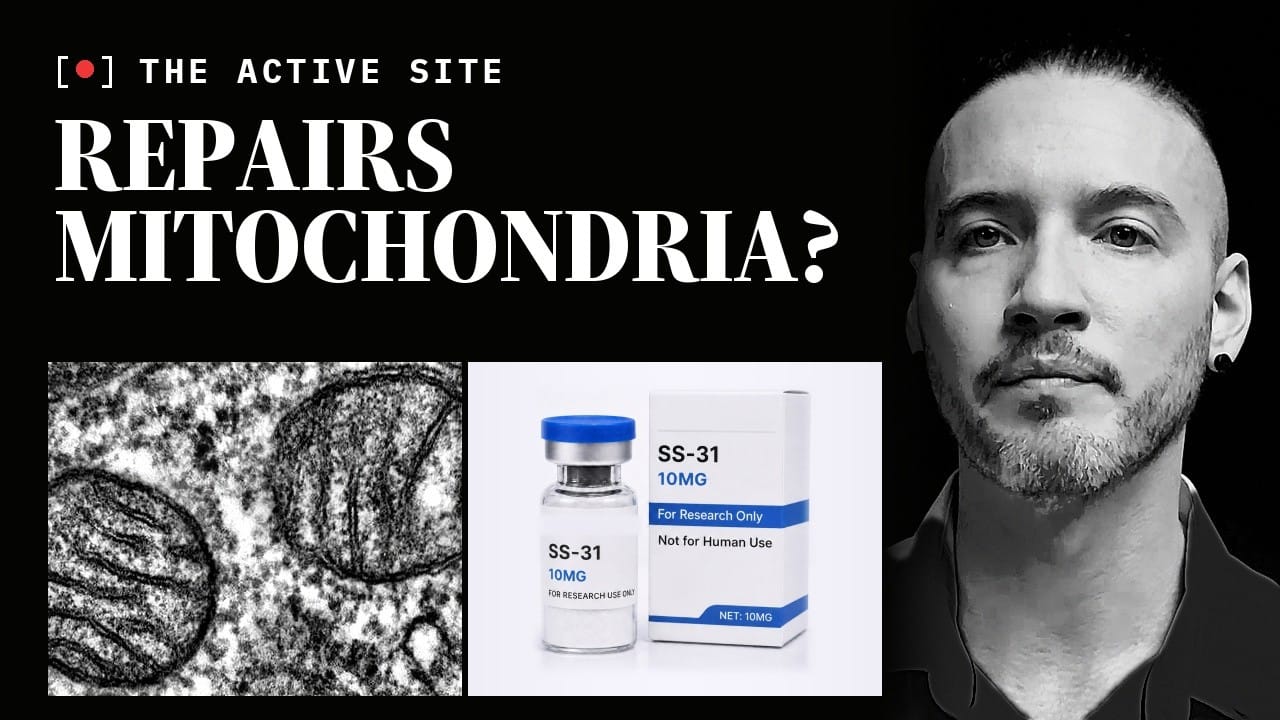
SS-31 is now an approved drug for one rare disease, Barth syndrome, and this week's episode walks through what the trials actually showed.
Or listen on Apple Podcasts or Spotify, or read it on the site.
This week's article
What the Trials Really Show About the Mitochondria Peptide SS-31
The written investigation that goes with this week's episode.
In this issue
- A twice-yearly cholesterol shot reduces heart attacks and strokes
- Two new reasons to lift
- Why BMI alone misjudges obesity, and a better check you can do at home
- Microplastics can make reactive oxygen in water, at least in a dish
- States have counted 14 measles deaths this year, while the CDC lists 9
- Telehealth companies start selling "peptides"
- Government scientists' draft verdict on glyphosate (Roundup)
- Medicare's third round of drug prices reaches doctor-given drugs
Research
1. A twice-yearly cholesterol shot reduces heart attacks and strokes
Lowering a number is not the same as preventing heart attacks, and every new heart drug has to show the second. This week inclisiran (Leqvio), a shot given twice a year, cleared that bar.
The numbers: In the ORION-4 trial, more than 16,000 people with heart disease got inclisiran or a placebo, and the drug significantly reduced heart attacks, strokes and related events. The company has not released the size of the reduction; full results come in the first half of 2027.
The catch: Until then, we do not know how big the benefit is or how it compares with statins. This announcement comes from the drug's maker.
What this means for you: Inclisiran is already approved for lowering LDL. If you have heart disease and struggle with daily pills, or your LDL is still high on a statin, it is worth asking your doctor about.
Why it's in this issue: It is the first proof that this new class of drug (small interfering RNA) reduces heart events, not just lowers a lab value.
Source: Novartis announcement, Nov 23, 2026. The trial is run by the University of Oxford with the TIMI Study Group.
2. Two new reasons to lift
Resistance training keeps showing up as the habit that protects you from the downsides of everything else, and this week brought two clean examples.
On a GLP-1: In an Australian trial, 120 adults took tirzepatide (Mounjaro or Zepbound) for 40 weeks, and half also lifted weights three times a week. Both groups lost the same weight, about 22.5 kg (50 lb), but the lifters lost about a quarter less muscle and other lean tissue, 3.6 kg versus 4.7 kg. Their bench press rose 4.7 kg while the non-lifters' fell 4.1 kg.
On depression: A review of 80 trials with about 6,100 people found that lifting eased depression symptoms moderately compared with doing nothing, and beat aerobic exercise, relaxation or stretching by a smaller margin.
The catch: The muscle trial was small and cannot say whether the saved muscle prevents falls or frailty later. The depression trials all lasted at least 3 weeks, so headlines calling lifting a "rapid" fix go further than the data.
What this means for you: If you are on a GLP-1, lifting three times a week is the simplest way to make sure the weight that comes off is mostly fat. If your mood is low, lifting is a reasonable add-on to care, not a replacement for it.
Why it's in this issue: Both studies were covered this week, and together they make the strongest case yet for strength training as a default.
Source: Green DJ, Yeap BB et al., Nature Medicine, Nov 9, 2026, DOI 10.1038/s41591-026-04752-5. O'Sullivan D, Herring MP et al., JAMA Network Open, Nov 16, 2026, DOI 10.1001/jamanetworkopen.2026.44254.
3. Why BMI alone misjudges obesity, and a better check you can do at home
BMI is a weight-to-height ratio from the 1800s that cannot tell muscle from fat or say where the fat sits. This study tested a new definition, proposed by a Lancet Commission in 2025, that adds a waist measurement and separates extra fat that is already harming how the body works from extra fat that is not yet.
The numbers: Across 844,108 adults in four long-running studies in China, the UK, the US and Spain, BMI alone missed obesity in 5 to 9 of every 100 people and wrongly flagged it in 1 to 3 of every 100. People with the "clinical" kind, with signs of organ harm, had about a 70% higher risk of dying during follow-up than people with neither obesity nor organ problems, versus about 20% higher for extra fat without organ harm. Obesity defined by BMI alone was not linked to a higher risk of death.
The catch: This is observational data, so it shows which definition tracks with risk, not that using it improves care. The senior author chaired the commission that proposed the definition, and several authors report industry fees, including from Novo Nordisk and Lilly.
What this means for you: Get a tape measure. A common rule of thumb is that your waist should be less than half your height. A large waist matters even if your BMI looks normal, and a high BMI with a normal waist, blood pressure, blood sugar and liver tests is a reason to keep watching rather than to panic.
Why it's in this issue: Nearly everyone has a BMI on file, and this definition could change who gets diagnosed with obesity and who is offered treatment.
Source: Pan A, Rubino F et al., Nature, Nov 11, 2026. DOI 10.1038/s41586-026-11237-5.
4. Microplastics can make reactive oxygen in water, at least in a dish
Plastic has long been treated as chemically inert. A Nature study found that tiny plastic particles in plain water generated hydroxyl radicals, one of the most reactive forms of oxygen there is. It is a real chemical finding, but it was measured in a dish, and much of the sharing online treated it as proof of harm in people, which it is not.
The numbers: Over 10 days in water, store-bought polystyrene powder broke down nearly 90% of a test dye, a standard sign that reactive oxygen is being made. The most water-repelling plastics, polyethylene and polypropylene, were the most active, and PET, the plastic in most drink bottles, was near the bottom. In blood serum the reaction ran about ten times weaker (read from a chart in the paper).
The catch: No people or animals were exposed. The particles were new lab powders at very high doses, not the worn plastic we actually encounter, and DNA damage was never tested. A senior author, Wei Min, told Chemical & Engineering News the findings deserve "serious attention, rather than a reason for immediate alarm."
What this means for you: Nothing here tells you to throw out your water bottles. Cutting your plastic exposure is a reasonable choice, but this paper is not evidence that you have to.
Why it's in this issue: It went viral in October, and most of the sharing claimed more than the paper showed. This is what it actually found.
Source: Qian N, Zhao R, Chan KY et al., Nature 658:650-657, Oct 14, 2026. DOI 10.1038/s41586-026-11141-y.
Health news that affects you
5. States have counted 14 measles deaths this year, while the CDC lists 9
Two official counts of the same thing have drifted apart. State health departments have reported 14 measles deaths in 2026: 9 in Pennsylvania, 3 in Wisconsin, 1 in New York and 1 in Virginia. The CDC's page, updated Nov 25 with data as of Nov 24, lists 9, up from 6 a week earlier.
The numbers: As of Nov 24, the CDC counted 6,039 confirmed cases this year, compared with 2,289 in all of 2025. About 1 in 9 people with measles has been hospitalized, and about 96% were unvaccinated or of unknown status.
The catch: The gap is mostly about counting. The CDC counts only deaths that federal reviewers have verified had measles as the underlying cause, while states count deaths they investigated themselves. The CDC says it is working on a standard definition, and its next update is Dec 4.
What this means for you: Check that you and your children have two doses of the MMR vaccine, which together are about 97% effective. If you can't find your records, your doctor can check your immunity or give you another dose.
Why it's in this issue: Deaths are the starkest measure of this year's outbreaks, and the two official counts don't agree.
Source: CDC, Measles Cases and Outbreaks, updated Nov 25, 2026, data as of Nov 24. Pennsylvania, Wisconsin, Virginia and New York state health department releases, Nov 2 to Nov 25, 2026.
6. Telehealth companies start selling "peptides"
Peptides went from bodybuilding forums to mainstream telehealth in one week, and the companies themselves say the products are not FDA approved.
The numbers: Hims & Hers launched a peptide service on Nov 18 with sermorelin, NAD+, glutathione, vitamin B12 and L-carnitine, with BPC-157 and TB-500 "later." Noom launched its own on Nov 17. In a Hims survey of 2,000 adults, 55% said they were interested in peptides.
The catch: An Oct 28 HHS policy lets certain compounding pharmacies make six specific peptides without enforcement action. That is not approval, and none of those six is on these launch menus yet.
What this means for you: Ask what the evidence is in people, not animals, for the exact peptide and dose. For most of these it is thin, and a clinician signing off does not change that.
Why it's in this issue: This is the moment peptides go mass-market, and readers will be pitched them.
Source: Hims & Hers announcement, Nov 18, 2026. Noom announcement, Nov 17, 2026. HHS enforcement discretion policy, issued Oct 28, 2026; published in the Federal Register Oct 30, 2026.
7. Government scientists' draft verdict on glyphosate (Roundup)
The National Institute of Environmental Health Sciences posted three draft reviews on glyphosate, the weed killer in Roundup. They lean toward a link with one blood cancer, mostly in people who spray it for a living. For the average person, this is a reason to use it carefully, not to panic about trace amounts in food.
The numbers: The human review found "some evidence" of a link with non-Hodgkin lymphoma and some of its subtypes, while evidence for myeloma and Hodgkin lymphoma was inconclusive. The animal review concluded that oral glyphosate caused tumors at three sites in rats and mice, including malignant lymphoma in male mice. Most of the human exposure data comes from farm and landscape workers.
The catch: These are drafts, not yet peer reviewed. They differ from the EPA, which said in 2020 that glyphosate is "not likely" to cause cancer and plans an update in early 2027.
What this means for you: If you spray it at home or work, wear gloves and long sleeves, avoid windy days and wash up after. If your only exposure is through food, these reviews do not tell you to change your diet.
Why it's in this issue: Roundup is one of the most-used chemicals in the country, and these draft NIEHS reviews lean toward a cancer link, though they are not an official NIH or HHS determination.
Source: NIEHS draft reviews posted Nov 19 to 20, 2026. Covered by The Washington Post, Nov 22.
8. Medicare's third round of drug prices reaches doctor-given drugs
Medicare's price negotiations now reach the drugs your doctor gives you in the office, not just the ones you pick up at the pharmacy. Those office-given drugs tend to be the most expensive.
The numbers: Medicare set new prices for 13 drugs, starting Jan 1, 2028. Four are given in a clinic and are used by about 120,000 people, and the rest are pharmacy drugs used by about 1.4 million. Medicare estimates the new prices would have cut 2025 net spending on these drugs by about 45%, or $9.2 billion, or by about 33% ($5.5 billion) if discounts drug makers already give are counted.
The catch: The new prices do not start for two years, and what you personally pay depends on your plan.
What this means for you: If you or a parent is on Medicare and takes one of these drugs, out-of-pocket costs may drop in 2028. Nothing changes this year.
Why it's in this issue: This is the first time negotiation reaches office-given drugs, which shapes what Medicare and later private insurers pay.
Source: CMS announcement, Nov 23, 2026.
In brief
The FDA turned down Capricor's deramiocel, a cell therapy for Duchenne muscular dystrophy, for a second time, and cited problems with how the main trial was analyzed and blinded. (Capricor, Nov 20)
The FDA approved giredestrant (Wilserdly), a new pill taken after surgery for the most common type of early breast cancer. At 3 years, 92.4% were free of invasive cancer, versus 89.6% on standard hormone therapy. (FDA, Nov 23)
Labels for drugs approved on early evidence, such as a shrinking tumor, will now say so and point patients to an FDA page explaining what that means. (FDA, Nov 23)
What to watch
AI therapy chatbots: A federal watchdog reported Nov 20 that no AI chatbot is FDA-authorized for mental health care, yet nearly 1 in 5 people aged 12 to 21 used one for mental health advice in 2025.
Two supplement recalls: 365 Whole Foods Market ashwagandha capsules (120-count) for possible Salmonella, and Green Lumber "Natural Fuel For Men" for hidden tadalafil, the drug in Cialis. (FDA, Nov 12 and Nov 24)
Medicare open enrollment ends Dec 7. If your plan's drug list changed, now is the time to compare.
If one of these changed how you think about something you're doing now, forward it to someone who would want to know.
William
This Week in Health Science: the newest research in medicine, health tech, nutrition and supplements, and what it means for you. If someone forwarded this to you, subscribe here.